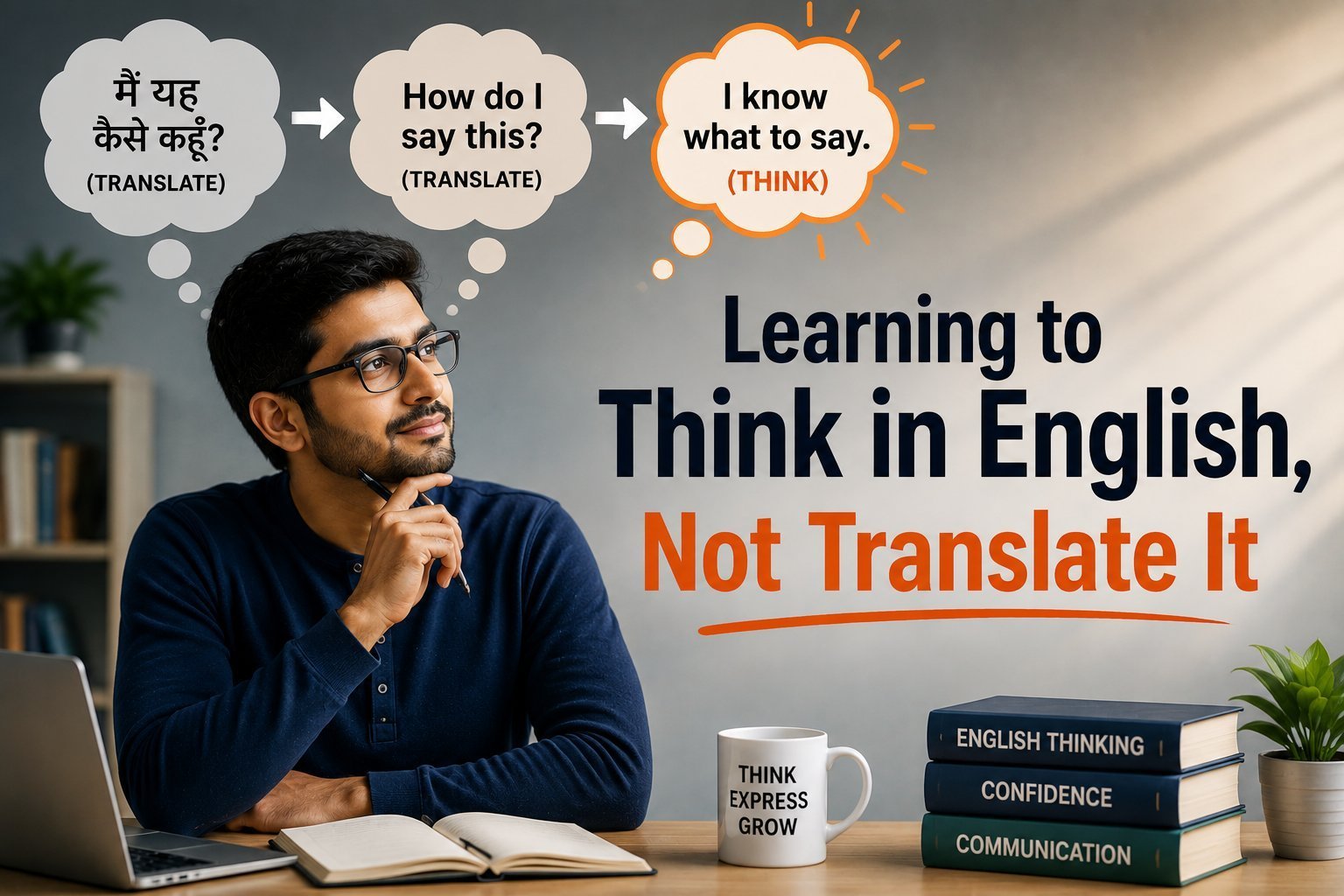
I was 20 years old, and I could not speak a single line in English. Forming even one sentence felt like a struggle. It made sense, in a way — none of my friends spoke English, so I never had a reason to practice it. Then I came across a group of migrants from overseas who spoke fluent English, and I watched how effortlessly they created a good first impression wherever they went. Something shifted in me after that.
The Change
I felt inferior, and that inferiority complex started devouring me from within. I knew I had to overcome it, so I sat down one day and asked myself a simple question: why am I so good at speaking Hindi? The answer came from within almost immediately — it's because I think in Hindi. That was the moment it clicked. If I wanted to speak English fluently, I first had to learn to think in English.

"Effort never goes wasted — it branches into things you never expected."
Thankfully, my dad had a library of books at home, and the first one I picked up was Dr. Wayne Dyer's "Pulling Your Own Strings." In the beginning, progress was painfully slow. It used to take me an entire day just to get through the first few pages. I would note down every word I didn't understand, look up its meaning in my Oxford Dictionary, write it down, and study the context it was used in until it made sense to me. Then I'd write five to ten sentences using each new word to make sure it stuck. In the early days, I was noting down around 15 new words per page. Gradually, as I read more, that number dropped to just 5. I kept at it for four to five hours every day.
Once I felt a bit more confident with reading, I moved on to watching English movies and TV serials with subtitles, pausing often to note down unfamiliar words. I still remember Frasier having the most difficult vocabulary of anything I watched — but I learned an enormous amount from it.
Six months in, English had sprouted in my mind, but it still hadn't reached my mouth. I would stutter or get stuck mid-sentence, most likely because I doubted myself. Interestingly, though, I was already able to write excellent emails by this point — so much so that my overseas friends couldn't believe it was actually me who had written them.
After another six months, without even realizing it, I found myself speaking fluently, with a solid vocabulary to back it up.
All that effort didn't just give me a new language — it gave me a habit of reading that changed the course of my life. Because I could speak English, I got a job. I could converse comfortably with foreigners. I could read and absorb knowledge across every field, since most of what's written in the world is available in English. I even went on to freelance as a soft skills trainer. And there was more beyond that.
Just like the effort I put into learning English branched out into a variety of unexpected benefits, my other efforts in life have branched out in similar ways too. Bottom line — effort never goes wasted.