The Erratic Apprentice
In 1726, twenty-year-old Benjamin Franklin returned to Philadelphia from London. While brilliant, ambitious, and widely read, Franklin was acutely aware that his character was undisciplined, inconsistent, and prone to reckless missteps.
During his apprenticeship as a printer, Franklin's sharp intellect frequently became a liability. He was argumentative and dogmatic, alienating friends and employers through sarcastic disputation. More seriously, his lack of moral discipline had led to painful ethical compromises: he had borrowed and spent money entrusted to him by a friend, fallen into debt, squandered earnings on frivolous entertainment, and engaged in indiscretions that violated his conscience.
Franklin realized that intellectual good intentions were powerless against the inertia of habit. In his own analysis, merely desiring to do good was insufficient; contrary inclinations, social pressures, and bad habits repeatedly overwhelmed good resolutions. Without a systematic method to govern his daily impulses, his ambition would remain at the mercy of chance. He decided that if he wished to live an honorable, effective, and prosperous life, he needed a practical technology to reshape his behavior.

"The virtue ledger transformed Franklin from an abrasive, indebted artisan into one of history's most versatile polymaths."

The Thirteen Virtues and the Daily Ledger
During his voyage back to Philadelphia, Franklin conceived what he termed his 'bold and arduous project of arriving at moral perfection.' Recognizing that abstract moralizing was ineffective, he designed a systematic behavioral tracking system:
1. The Thirteen Specific Virtues: Franklin identified thirteen core virtues essential for personal effectiveness, attaching a concise, actionable rule to each:
- Temperance: Eat not to dullness; drink not to elevation.
- Silence: Speak not but what may benefit others or yourself; avoid trifling conversation.
- Order: Let all your things have their places; let each part of your business have its time.
- Resolution: Resolve to perform what you ought; perform without fail what you resolve.
- Frugality: Make no expense but to do good to others or yourself; waste nothing.
- Industry: Lose no time; be always employ'd in something useful; cut off all unnecessary actions.
- Sincerity: Use no hurtful deceit; think innocently and justly, and, if you speak, speak accordingly.
- Justice: Wrong none by doing injuries, or omitting the benefits that are your duty.
- Moderation: Avoid extremes; forbear resenting injuries so much as you think they deserve.
- Cleanliness: Tolerate no uncleanliness in body, cloaths, or habitation.
- Tranquillity: Be not disturbed at trifles, or at accidents common or unavoidable.
- Chastity: Rarely use venery but for health or offspring, never to dullness or injury of reputation.
- Humility: Imitate Jesus and Socrates. (Franklin added Humility later after a Quaker friend gently informed him that he was widely considered overbearing and arrogant).
2. Rotational Weekly Focus: Understanding cognitive bandwidth long before modern psychology, Franklin realized that attempting to master all thirteen virtues simultaneously scattered focus and guaranteed failure. Instead, he chose to focus intensely on one virtue per week. While keeping other virtues under general watch, he guarded primarily against faults in the target virtue.
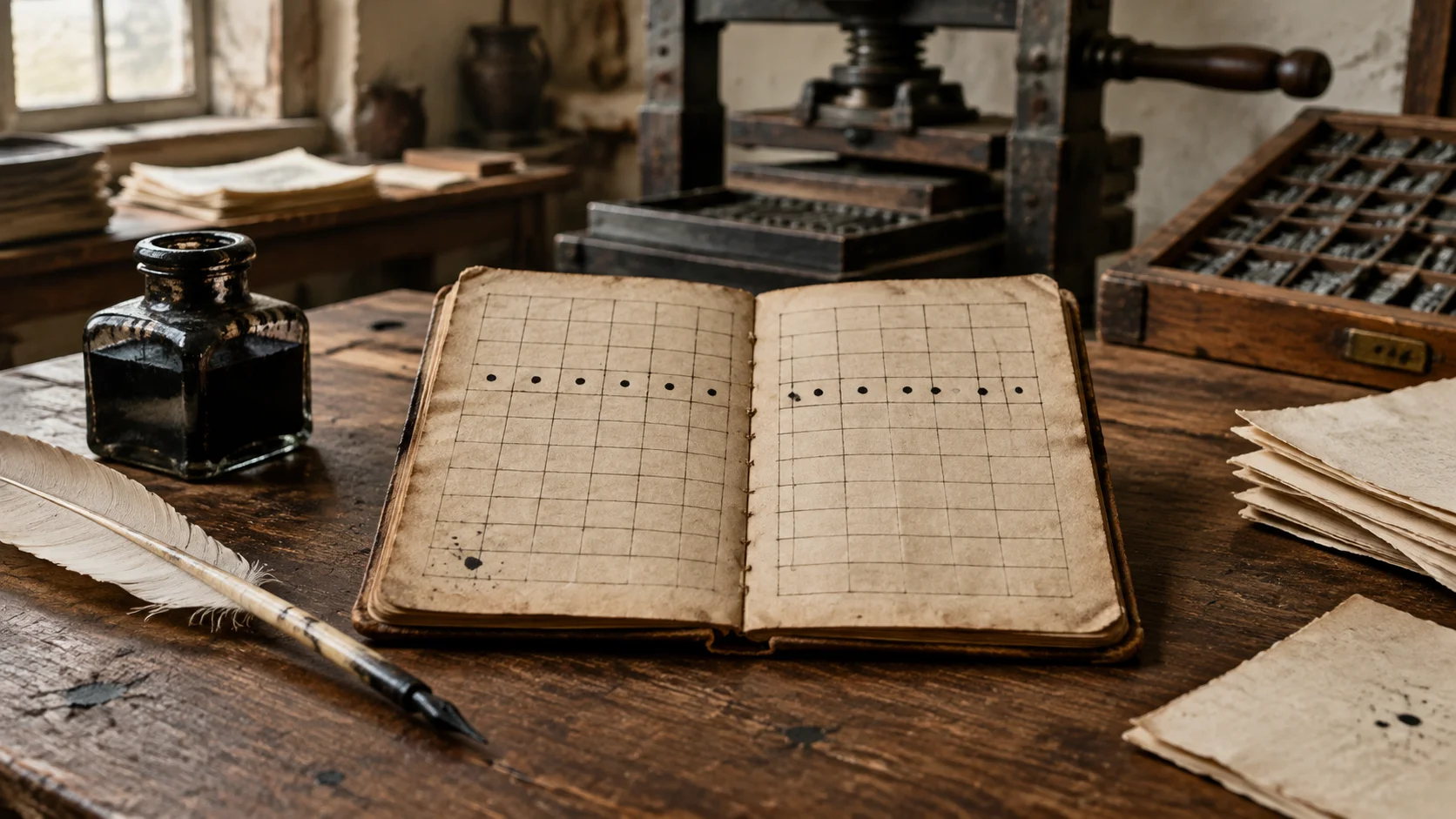
3. The Pocket Tracking Ledger: Franklin constructed a small pocket notebook. Each page was dedicated to one virtue, ruled with a grid of seven columns (one for each day of the week) and thirteen horizontal rows representing the virtues. Every evening before bed, Franklin conducted a strict self-examination. If he had committed a fault against any virtue that day, he made a black ink dot in the corresponding cell. His goal was to keep the row of the week's focal virtue clean of dots.
4. The Compounding Cycle: Progressing through one virtue per week took thirteen weeks, allowing Franklin to complete four full courses of self-examination every year. Over time, he was gratified to see his ledger pages progressively cleared of marks.
5. The Daily Scheme: To govern his time, Franklin formulated a daily routine: waking at 5:00 AM for study, breakfast, and his morning question: 'What good shall I do this day?'; working from 8:00 AM to 12:00 PM; dining and reading from 12:00 PM to 2:00 PM; working from 2:00 PM to 6:00 PM; and spending the evening in conversation, supper, putting things in order, and his nightly ledger review with the question: 'What good have I done today?'.
Franklin encountered immense resistance, particularly with Order. Keeping papers and tools in exact places proved exhausting for an active printer. At times, he was tempted to settle for being a 'speckled axe'—accepting mediocrity because grinding out flaws was hard work. Yet he persisted, carrying his notebook everywhere for decades.
From Printer's Bench to World Stage
The cumulative impact of this behavioral system transformed Franklin from an erratic, indebted artisan into one of the most prolific, accomplished, and universally respected polymaths in global history.
The discipline instilled by his ledger enabled Franklin to establish the Pennsylvania Gazette, publish Poor Richard's Almanack, and retire from active business at age forty-two with complete financial independence. His freed time was channeled into scientific discovery and civic innovation. He conducted groundbreaking experiments in electricity, invented the lightning rod, the Franklin stove, and bifocals, and founded the first subscription library, volunteer fire department, and the University of Pennsylvania.
On the world stage, the deliberate cultivation of Humility and Silence reshaped his diplomacy. Substituting dogmatic assertions with modest inquiry—using phrases like 'I imagine' or 'it appears to me'—he became a master negotiator. He secured the critical French alliance during the American Revolution, negotiated the 1783 Treaty of Paris, and contributed to drafting both the Declaration of Independence and the United States Constitution.
At age seventy-nine, looking back upon his life while writing his memoirs in France, Franklin explicitly credited his daily ledger for his extraordinary trajectory: 'It may be well my posterity should be informed that to this little artifice, with the blessing of God, their ancestor ow'd the constant felicity of his life, down to his 79th year, in which this is written.'