The Journalist Who Forgot Everything
In 2005, twenty-two-year-old freelance science journalist Joshua Foer considered himself the owner of a decidedly mediocre, leaky memory. In his daily life in Washington, D.C., he routinely forgot where he had parked his car, misplaced his house keys, blanked on phone numbers, and forgot his girlfriend's birthday. Like most modern adults outsourced to smartphones and digital calendars, he assumed that human memory was a fixed biological hardware trait—some people were born with photographic recall, and the rest were destined to forget.
In March 2005, Foer traveled to Manhattan to cover the U.S. Memory Championship for 'Slate' magazine. Expecting to find a gathering of neurological savants similar to 'Rain Man', he watched competitors memorize hundreds of random digits in minutes and recall the exact order of shuffled decks of playing cards.
When Foer interviewed British Memory Grandmaster Ed Cooke outside the competition hall, Cooke dismantled his assumptions. None of the competitors possessed photographic memories or abnormal IQs; on standardized cognitive tests, their brains were completely average. Instead, they were using a 2,500-year-old cognitive technology developed by the Greek poet Simonides of Ceos and championed by Roman orators like Cicero: the Method of Loci, commonly known as the 'Memory Palace'. Cooke issued a bold challenge: if Foer practiced thirty to sixty minutes a day, he could return the following year not as a journalist, but as a contender.
Building Palaces and Breaking the 'OK Plateau'
Skeptical yet intrigued, Foer agreed to become his own journalistic guinea pig. Partnering with Ed Cooke as his coach and consulting with Florida State University psychologist Dr. K. Anders Ericsson—the world's leading authority on deliberate practice—Foer embarked on a rigorous one-year cognitive training regimen:
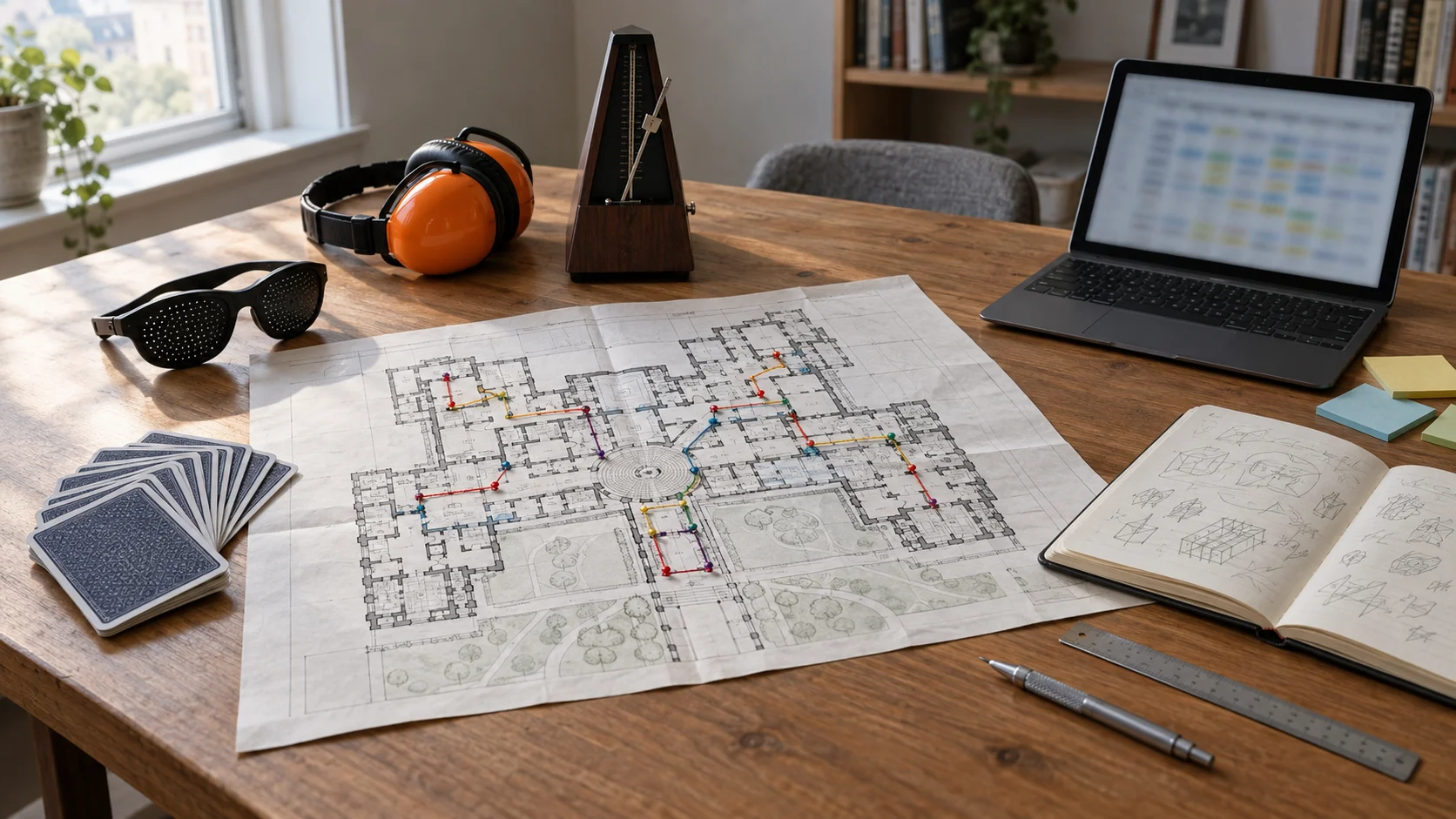
1. Constructing Architectural Memory Palaces: The human brain did not evolve to remember abstract numbers, binary code, or lists of names; it evolved as a hunter-gatherer organ with extraordinary spatial and visual memory for navigating physical landscapes. Foer began building dozens of 'Memory Palaces' in his imagination—using the floor plans of his childhood home in Washington, D.C., his high school, and relatives' apartments. To memorize a list of items, he mentally walked through a familiar building in a strict, sequential route, placing each item in a specific architectural locus (by the front mailbox, on the foyer table, inside the kitchen sink).
2. Elaborative Encoding (The Bizarre and multisensory): Abstract facts slide off the mind like water off glass. To make memories stick, Foer practiced 'elaborative encoding'—translating dry data into absurd, multisensory, emotionally charged, and wildly vivid mental animations. When Cooke gave him his very first grocery list to place in his childhood home, Foer visualized a giant jar of pickled garlic at the front driveway, Cottage cheese filling a bathtub with a model swimming in it, and three costumed chickens hanging from a chandelier. The weirder, funnier, or more visceral the image, the more deeply it hooked into the hippocampus.
3. The Person-Action-Object (PAO) System for Numbers and Cards: To memorize thousands of digits and playing cards at high speed, Foer spent months constructing a 52-card and 100-number Person-Action-Object (PAO) matrix. Every playing card was permanently assigned a specific person, an action, and an object (for example, the King of Hearts was Michael Jackson moonwalking with a white glove; the Ace of Spades was Albert Einstein). By combining three cards into a single composite mental scene—Person from Card 1 doing the Action of Card 2 to the Object of Card 3—he compressed an entire 52-card deck into just seventeen vivid mental images placed along a seventeen-stop Memory Palace route.
4. Overcoming the 'OK Plateau' via Deliberate Practice: Five months into training, Foer's card-memorization speed stalled at the 'OK Plateau'—the point where a skill becomes automated and stops improving. Consulting Dr. Anders Ericsson, Foer applied the science of deliberate practice: he bought a metronome to force himself to flip cards faster than his comfort zone, wore earmuffs and blacked-out goggles with tiny pinholes to eliminate visual distractions, and kept a granular spreadsheet analyzing every single mistake to repair weak images in his PAO system.
The 100-Second Record and Global Impact
In March 2006, exactly one year after attending the tournament as a spectator, Foer returned to the U.S. Memory Championship in New York City as a competitor.
Sitting under television lights with his noise-blocking earmuffs and pinhole goggles, Foer stunned the veteran field. In the 'Speed Cards' event, he memorized the exact sequence of a shuffled 52-card deck in just 1 minute and 40 seconds (100 seconds), shattering the existing United States national record. Advancing to the championship finals, he defeated the defending champion in the 'Tea Party' and 'Double Deck of Cards' events to be crowned the 2006 USA Memory Champion.
Later that year, he represented the United States at the World Memory Championships in London, finishing thirteenth overall in the world.
In 2011, Foer published 'Moonwalking with Einstein: The Art and Science of Remembering Everything' (Penguin Press). The book became an instant #1 New York Times bestseller, translated into more than thirty-five languages, and his 2012 TED Talk, 'Feats of Memory Anyone Can Do', garnered millions of views worldwide.
Joshua Foer proved that an exceptional memory is not an innate genetic lottery reserved for savants; it is a trainable skill of attention, imagination, and spatial organization. By resurrecting the ancient art of the Memory Palace, he demonstrated that when we learn how to pay deep, imaginative attention to the world, we reclaim our capacity to remember.