The Tyranny of the Discard Pile
From early childhood in Tokyo, Marie Kondo harbored an intense, almost frantic obsession with order. At five years old, while her peers played outside, Marie devoured home decor and housekeeping magazines borrowed from her mother. By junior high school, she was volunteering as the classroom bookshelf organizer and spending every afternoon rearranging her family's home.
Yet her early passion was poisoned by conventional organizational dogma. Following standard advice found in Japanese lifestyle guides, Kondo treated decluttering as a perpetual war of elimination. She bought endless plastic storage bins, drawer dividers, and modular shelves, meticulously categorizing every corner of her room. She adopted ruthless disposal rules, discarding things simply because they had not been used in six months. She even began secretly purging her parents' and siblings' possessions—throwing out her brother's action figures and her mother's unused bags—which led to severe reprimands and being banned from cleaning family areas.
Despite her manic efforts, clutter always returned. Storage bins merely concealed piles of unloved objects behind plastic lids, creating what Kondo termed 'rebound clutter' (the boomerang effect). Her room became a source of claustrophobic anxiety rather than peace. She felt permanently exhausted, caught in an endless cycle of sorting, purging, and relapsing.

Do not organize to hide things in bins, and do not tidy by focusing on what to throw away. Hold each possession with both hands, ask yourself if it truly sparks joy in your heart, thank the rest for their service, and surround yourself only with what elevates your life.

The crisis peaked during high school. One afternoon, overwhelmed by the visual chaos of her room and the futility of her efforts, Kondo suffered a nervous breakdown and collapsed unconscious onto the tatami floor, remaining blacked out for two hours.
The Voice on the Floor and the Awakening of Joy
When Kondo regained consciousness on her bedroom floor, she experienced a profound cognitive breakthrough. Looking at the surrounding mess, a sudden insight echoed in her mind: 'Look at things more closely.'
In that moment of vulnerability, she diagnosed the fatal flaw in her entire approach. For over a decade, she had been motivated by resentment, irritation, and scarcity—focusing entirely on what to discard. Hunting for things to throw away kept her mind fixated on negativity. True organization, she realized, required the exact opposite orientation: focusing exclusively on what to keep. Tidying was not about creating an empty room; it was about curating a sacred environment filled only with objects that elevated one's life.
Drawing inspiration from her years working as a Shinto shrine maiden (miko), where cleanliness and reverence for physical spaces were sacred spiritual disciplines, Kondo formulated an unyielding personal system:
1. The 'Spark Joy' (Tokimeki) Criterion: Instead of rationalizing whether an item might be useful someday, Kondo established an intuitive, somatic test. She required herself—and later her clients—to physically pick up and hold every single possession with both hands. She trained herself to notice the body's visceral response: tokimeki—a subtle flutter of warmth, elevation, and cellular lightness in the chest—versus the heaviness, tension, or indifference provoked by unloved clutter. If an item did not spark joy, it had no place in her future.
2. Tidy by Category, Never by Location: Traditional decluttering advises cleaning one room at a time, which guarantees failure because similar items are scattered across multiple closets. Kondo mandated gathering every item belonging to a single category into one giant pile on the floor, confronting the true volume of one's consumption. She set a strict, psychological order: Clothes first (easiest), followed by Books, Papers, Komono (Miscellaneous items), and finally Sentimental keepsakes (most difficult).
3. The Gratitude Release: Parting with possessions often triggers paralyzing guilt and regret. To dissolve this emotional friction, Kondo instituted a ritual of thanking each departed object: 'Thank you for keeping me warm,' or 'Thank you for teaching me that this style does not suit me.' Acknowledging an object's completed service provided emotional closure, liberating the owner to let go without shame.
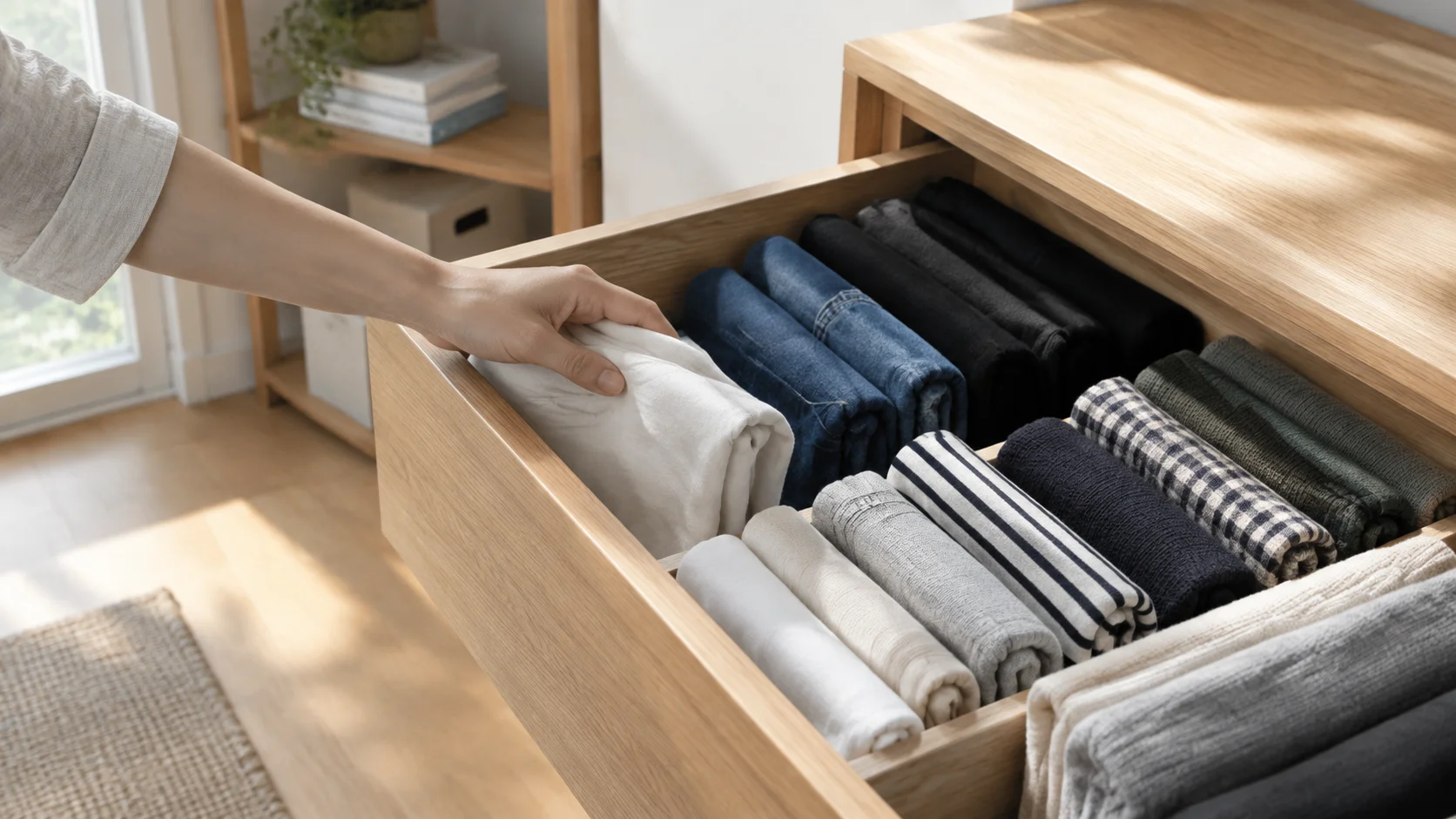
4. Vertical Folding and Storage Architecture: Rather than stacking clothing in suffocating piles where bottom layers remain unseen and forgotten, Kondo invented a simple geometric origami-like folding technique. Clothes were folded into smooth, upright rectangles that stood vertically on edge in drawers. Opening a drawer revealed every garment at a glance, eliminating drawer rummaging and maintaining structural order.
5. The Home as a Living Sanctuary: She designated a permanent, sacred home for every remaining possession, returning items to their designated places at the end of each day. Tidying ceased to be a daily chore; it became a one-time transformative festival followed by effortless maintenance.
The Global Movement for Intentional Living
By applying this rigorous system, Kondo eliminated rebound clutter from her life forever. Her home transformed into a luminous sanctuary of calm and clarity.
Recognizing that the struggle with possessions reflected deeper psychological attachments and anxieties, Kondo launched a personal organizing consultancy while studying sociology at Tokyo Woman's Christian University. Word of her transformative method spread across Tokyo through word-of-mouth, creating a six-month waiting list. Clients reported that decluttering their homes ignited dramatic life changes: ending toxic relationships, changing careers, losing weight, and achieving financial clarity.
In 2011, Kondo distilled her philosophy into 'The Life-Changing Magic of Tidying Up'. The book became an unprecedented global publishing phenomenon, selling more than thirteen million copies in over forty languages and topping the New York Times bestseller list for eighty-six consecutive weeks.
In 2015, Time magazine named Kondo one of the 100 Most Influential People in the World. Her 2019 Netflix documentary series, 'Tidying Up with Marie Kondo', earned multiple Emmy nominations and catalyzed an international cultural movement, prompting massive waves of donations to thrift stores worldwide.
Marie Kondo turned the mundane task of housecleaning into an art of mindful self-inquiry. Her journey demonstrates that when we take command of our physical surroundings with discernment and gratitude, we reclaim sovereignty over our inner lives.