The Golden Cage of Prodigy Fame
At age six, Josh Waitzkin discovered chess on the concrete tables of New York City's Washington Square Park. Guided by fierce street players and master coach Bruce Pandolfini, he rose through the junior ranks with astonishing speed, winning his first national championship at nine and earning the title of National Master at thirteen.
In 1993, when Waitzkin was sixteen, his childhood became the subject of the Hollywood film 'Searching for Bobby Fischer', based on a book written by his father, Fred Waitzkin. Overnight, Waitzkin was thrust into an overwhelming global media frenzy. Everywhere he traveled, cameras tracked his moves, and commentators labeled him the next American chess savior.
The sudden fame proved toxic to his development. Waitzkin was ensnared by what psychologist Carol Dweck calls an 'entity theory of intelligence'—the belief that his worth stemmed from innate genius rather than continuous effort. Winning was no longer a joyful exploration of an art; it became a desperate defense of his identity. Terrified of failing under the public eye, he grew tense at the board. The need to win at all costs suffocated his creative intuition. In his late teens and early twenties, exhausted by external expectations and suffering painful tournament losses, Waitzkin hit an agonizing wall of psychological burnout. As he later confessed, he became deeply alienated from the game he loved.

Do not let your ego trap you into protecting what you already know. Step into arenas where you are outmatched, invest in loss, break complex skills into microscopic components, and train your mind to flow through chaos rather than demanding perfection.

The Dojo Floor and the 'Investment in Loss'
Recognizing that his relationship with competition was broken, Waitzkin made a radical decision: he stepped away from professional chess. He realized that if he wanted to understand true mastery, he needed to start from zero in a discipline where he had no natural talent, no reputation, and no protective mantle of childhood genius.
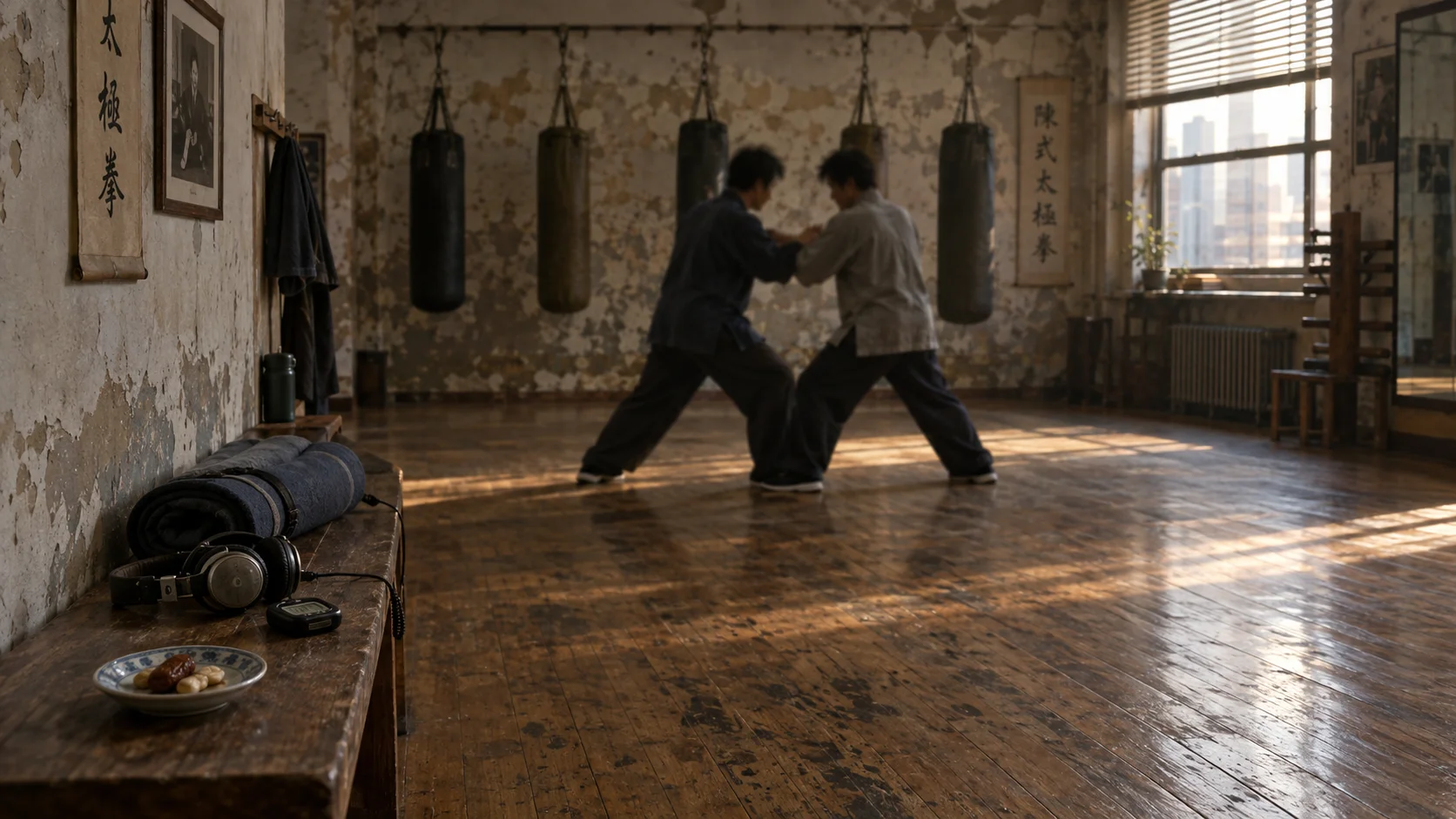
In 1998, at age twenty-two, he walked into the Manhattan school of Grandmaster William C. C. Chen to study Chen-style Tai Chi Chuan, specifically its full-contact martial application known as Push Hands.
Over the next eight years, practicing five to eight hours a day, Waitzkin systematically deconstructed the learning process, formulating a deliberate practice methodology:
1. 'Investment in Loss': The cornerstone of Waitzkin's philosophy was the deliberate surrender of ego. Most practitioners protect their pride by sparring with weaker opponents. Waitzkin did the opposite: he sought out the most formidable, brutal training partners in the dojo—veterans who threw him across the room, bruised his ribs, and exposed every technical flaw. Instead of reacting with frustration, he welcomed each defeat as an invaluable diagnostic tool, systematically analyzing why he lost balance and correcting the micro-mechanic.
2. 'Making Smaller Circles': Rather than collecting a vast arsenal of superficial techniques, Waitzkin focused intensely on depth over breadth. He took a single basic movement—such as a subtle redirection of force through the hips—and practiced it tens of thousands of times until the mechanics became completely automated in his subconscious. Once internalized, he gradually condensed the external movement, making the physical circle smaller and smaller until the leverage became practically invisible to his opponents.
3. The 'Soft Zone' Architecture: In competitive chess and martial arts, athletes often rely on a fragile 'Hard Zone'—demanding absolute silence, ideal temperatures, and perfect conditions to perform. When unexpected noise or bad refereeing occurs, their focus shatters. Waitzkin deliberately trained himself in the 'Soft Zone': practicing in sweltering heat, with blaring background noise, under physical exhaustion, and against opponents who fought dirty. He learned to accept disruptions with psychological fluidity, using external chaos to sharpen his concentration rather than derail it.
4. Conditioning the Flow State Trigger: To eliminate pre-competition anxiety, Waitzkin developed a four-step psychological anchor: eating a light, specific snack, completing fifteen minutes of stretching, doing ten minutes of meditation, and listening to a designated piece of music. After repeating this ritual hundreds of times before peak training sessions, the sequence became an autonomic trigger. By simply initiating the routine, his nervous system dropped into a state of relaxed hyper-focus on command.
The World Stage and the Principles of Mastery
The ultimate test of Waitzkin's architecture arrived in November 2004 at the Tai Chi World Cup in Taiwan—the premier global tournament for Push Hands. Competing against lifelong Taiwanese and mainland Chinese champions on their home soil, Waitzkin advanced to the finals against a formidable, heavier competitor known as 'The Buffalo'.
Early in the championship bout, an illegal foul from his opponent severely broke Waitzkin's right hand. In past years, such a catastrophe would have triggered panic. Instead, relying on years of 'Soft Zone' conditioning, Waitzkin immediately accepted the reality of his injury, shifted his tactical strategy, and fought the rest of the grueling match using his left arm and superior biomechanical leverage. Waitzkin emerged victorious, becoming the World Champion in full-contact Push Hands.
He later applied the identical learning principles to Brazilian Jiu-Jitsu, earning a black belt from nine-time world champion Marcelo Garcia.
In 2007, Waitzkin synthesized his eight-year journey in the landmark book 'The Art of Learning: An Inner Journey to Optimal Performance.' He demonstrated that excellence is not an innate gift bestowed upon a chosen few, but a trainable, replicable science of psychological presence and deliberate practice. Through The JW Foundation, Waitzkin brought these principles to educational institutions and went on to train world-class performers, chess grandmasters, and elite financial leaders in the art of cultivating a growth mindset under pressure.