A Mind Like Grasping Water
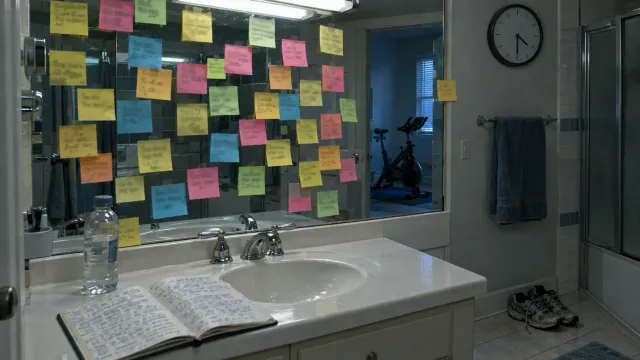
Growing up in the late 1980s and 1990s, long before classroom accommodations and executive-function coaching were widely available, Ryder Carroll lived inside a mind that refused to sit still. Diagnosed early in life with Attention Deficit Hyperactivity Disorder (ADHD), Carroll experienced his thoughts like a torrential downpour—dozens of competing ideas, impulses, and obligations firing simultaneously with no mechanism to sort or hold them.
In traditional classrooms, the consequences were immediate. Struggling with severe distraction, chronic procrastination, hyperactivity, and overwhelm, Carroll routinely missed assignments, lost track of instructions mid-sentence, and stared at blank pages while peers moved ahead. Teachers, classmates, and family members prophesied a bleak future for him given his learning disabilities. Internalizing their frustration, Carroll grew up haunted by anxiety and the isolating shame of being seen as the "dumb kid."
Whenever he tried conventional organizational tools—pre-printed academic planners, rigid calendar grids, or linear to-do lists—they collapsed within days. Standard planners demanded that he categorize thoughts into predetermined boxes and write in lengthy sentences. For an ADHD brain, the friction of flipping to the right section or writing out full paragraphs derailed his focus; by the time he finished the first sentence, the rest of the thought had evaporated. Holding thoughts in working memory, as Carroll later described in his TEDxYale talk, felt like "trying to grasp water."
Rapid Logging, Modular Indexing, and Monthly Migration
Refusing to accept the dismal future predicted for him, Carroll turned to the only distraction-free tool at his disposal: a blank paper notebook and a pen. Beginning in his youth and continuing through university in the late 1990s and his early career as a digital product designer, he spent twenty years testing and iterating stripped-down behavioral techniques designed for how an easily overwhelmed mind operates:
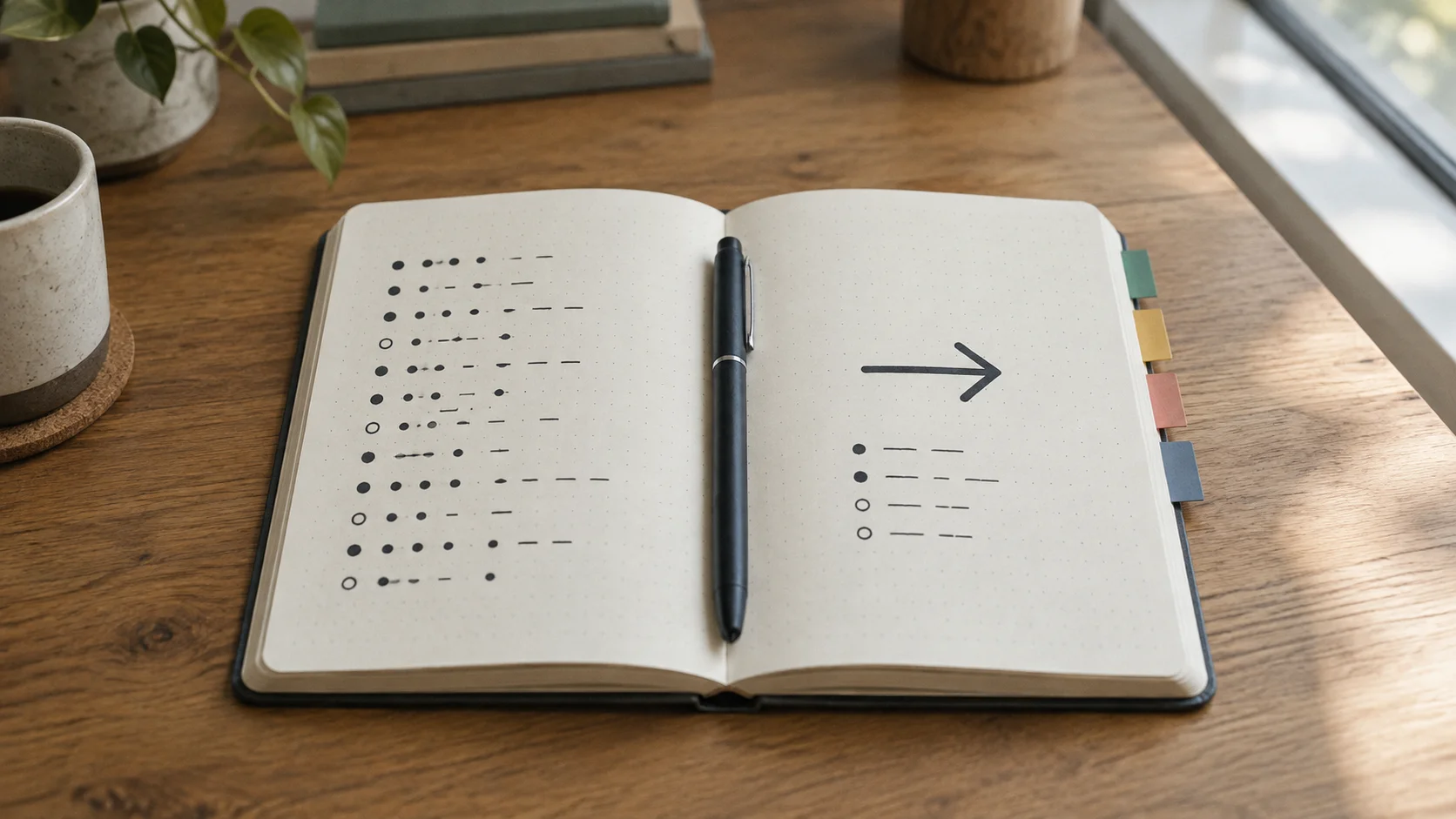
1. Rapid Logging in Short-Form Bullets: Recognizing that traditional journaling took too long and caused his attention to wander, Carroll stripped written capture down to bare essentials. Influenced by industrial designer Dieter Rams's maxim "less, but better," he trained himself to capture thoughts in crisp, objective, telegraphic phrases rather than full sentences. To make entries scannable at a glance, he paired each line with a simple symbol: a dot (•) for actionable tasks, an open circle (○) for events, and a dash (—) for factual notes.
2. Writing in All-Caps for Deliberate Slowness: Because his hurried cursive handwriting often degenerated into illegible scrawls under stress, Carroll trained himself to write in all-capital block letters using a fine-liner pen. This physical constraint solved two problems at once: it forced his racing mind to slow down just enough to shape each letter legibly, and it compelled him to be economical with his word choice.
3. The Blank-Page Index and Modular Collections: Rather than fighting pre-printed calendar templates that left wasted pages whenever he skipped a week, Carroll numbered the corners of a blank notebook and reserved the first pages as a running Index. Any time a project, habit tracker, or meeting required space, he turned to the next blank spread, gave it a topic header (a "Collection"), and logged its page numbers in the Index. Nothing got lost, and no empty dated boxes induced guilt.
4. Monthly Migration (Handwriting Friction as an Intentional Filter): At the end of every month, Carroll audited every open task dot from the previous thirty days. To carry an unfinished task forward into the new Monthly Log, he required himself to physically copy the task out by hand, turning the old dot into a right-pointing arrow (>). This mechanical friction became his filter against mental clutter: if an unfinished task was not worth the ten seconds required to rewrite it by hand, he crossed it out entirely.
5. Shifting From Process ("How") to Purpose ("Why"): As his paper system cured his disorganization, Carroll rose rapidly—becoming the youngest art director at a major U.S. fashion brand, leading a New York City design agency, and winning multimillion-dollar software contracts. Yet at a career peak, he felt an acute wave of emptiness and realized he had mastered efficiency without asking what he actually valued. He expanded his daily AM and PM notebook check-ins into a practice of self-inquiry—auditing every task during Migration not just by "How do I get this done?" but by "Why does this deserve my time at all?"
From Personal Survival Tool to Global Movement
By pairing rapid external capture with regular reflective pruning, Carroll transformed his greatest vulnerability into calm clarity and creative leadership. He directed major digital design projects for Adidas, American Express, Cisco, HP, IBM, and Macy's, while working on far fewer, more meaningful commitments.
"Stop trying to hold competing tasks inside your head—capture them immediately on paper in short, simple phrases, and regularly rewrite only the commitments that still genuinely matter to your life."
In 2013, after sharing his notebook system with friends who struggled with similar attention challenges, Carroll launched a website explaining his framework: the Bullet Journal (BuJo). What began as a personal survival tool for a kid with ADHD grew into a worldwide analog movement adopted by millions.
In 2017, Carroll delivered his TEDxYale talk, "How to Declutter Your Mind — Keep a Journal," and in October 2018, he published The Bullet Journal Method: Track the Past, Order the Present, Design the Future (Portfolio / Penguin Random House), a New York Times bestseller translated into over twenty-five languages. By designing a system around human limitations rather than against them, Carroll proved that focus is a trainable daily practice of externalizing thoughts and choosing what truly matters.