A One-in-Five-Hundred Death Sentence
In August 1964, Norman Cousins was at the summit of his intellectual career. For over two decades, he had served as the influential editor-in-chief of the 'Saturday Review', shaping American literary and cultural dialogue. But following an exhausting diplomatic journey to the Soviet Union, his body abruptly betrayed him.
It began with a slight fever and general malaise. Within days, the condition exploded into agonizing, systemic joint pain. His spine, neck, and limbs stiffened into immobility. Hard nodules formed under his skin, and his jaw locked so severely that he could barely open his mouth to chew.
Hospitalized in New York under the care of his long-time physician and friend, Dr. William Hitzig, medical specialists delivered a catastrophic diagnosis: ankylosing spondylitis, a severe, progressive degenerative collagen illness where the immune system attacks connective tissues, causing spinal vertebrae to fuse. His erythrocyte sedimentation rate (ESR)—the primary clinical marker of bodily inflammation—soared past 80, indicating acute breakdown.
The prognosis was bleak: Dr. Hitzig candidly informed Cousins that specialists gave him a 1-in-500 chance of recovery. Confined to a hospital bed, barely able to move his arms, and prescribed massive daily doses of heavy painkillers and anti-inflammatory drugs that upset his digestive tract, Cousins felt the cold panic of helplessness. He observed that the hospital environment itself—constant interruptions, lack of restful sleep, toxic dread, and passive medical surrender—was actively eroding his biological vitality.
The Hotel Room Laboratory and Marx Brothers Film Rolls
Lying in his hospital bed, Cousins decided to take intellectual ownership of his survival. He reflected on the seminal endocrinological research of Dr. Hans Selye on the biology of stress. Selye had demonstrated that negative emotional states—fear, despair, rage, and chronic helplessness—flood the body with adrenal exhaustion, depress the immune system, and degrade tissue.
Cousins posed a bold, counterintuitive hypothesis: If negative emotions produce negative chemical changes in the human body, can positive emotions produce positive chemical changes? Could hope, joy, faith, laughter, and the fierce will to live restore endocrine balance and spark biological regeneration?
With the full support of Dr. Hitzig, Cousins executed a radical, self-directed healing protocol:
1. Checking Out of the Hospital Sanctuary: In late 1964, Cousins discharged himself from the hospital and moved into a quiet hotel room. The hotel room was half the cost of a hospital bed, free from middle-of-the-night blood draws, and provided an environment of tranquility, autonomy, and psychological dignity.
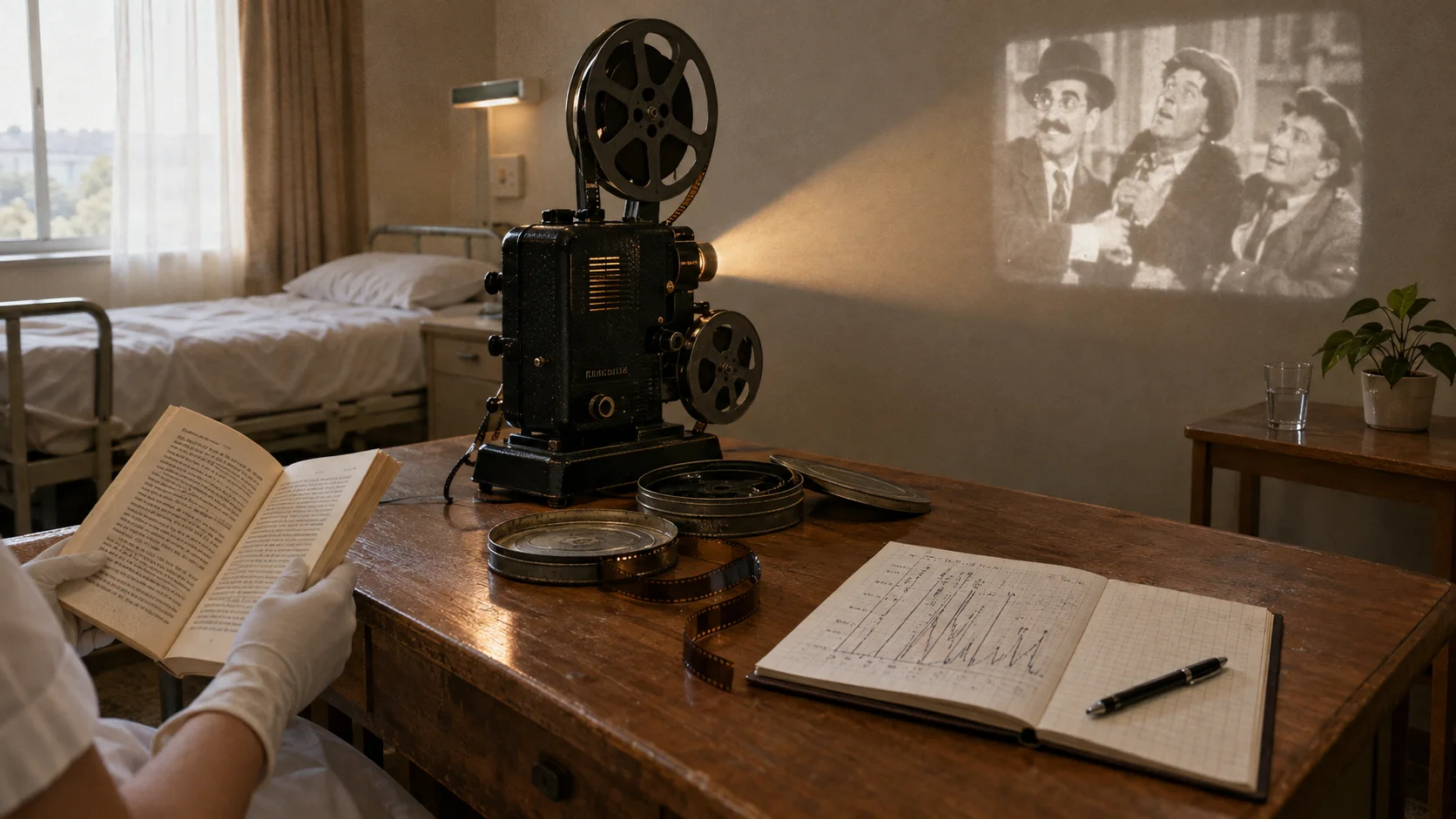
2. The Deliberate Prescription of Laughter: To test his hypothesis, Cousins obtained a 16mm film projector and tracked down classic comedy reels: old Marx Brothers films ('Animal Crackers', 'A Night at the Opera') and episodes of Allen Funt's 'Candid Camera'. He instructed his nurse to read humorous books aloud. He forced himself to laugh—not polite chuckles, but deep, visceral belly laughs that shook his entire diaphragm.
3. The Discovery of the Laughter Anesthetic: The results were immediate and startling. Cousins made what he called a 'joyous discovery': ten minutes of genuine belly laughter had an anesthetic effect, allowing him at least two hours of completely pain-free, natural sleep without sedatives. When the pain returned, they reloaded the projector and repeated the process.
4. Objective Biological Validation: Cousins refused to rely on wishful thinking. He insisted on clinical verification. Before each comedy session, Dr. Hitzig took blood samples to measure his sedimentation rate. Invariably, after a session of laughter, his sedimentation rate dropped by at least five points. Laughter was not merely lifting his spirits; it was actively reducing systemic inflammation at the cellular level.
5. Intravenous Ascorbic Acid (Vitamin C): In partnership with Dr. Hitzig, Cousins administered massive intravenous doses of Vitamin C to support collagen synthesis, based on the rationale that ascorbic acid combats tissue inflammation without the destructive side effects of synthetic steroids.
6. The Principle of Active Partnership: Cousins rejected the traditional posture of the passive, submissive patient. He viewed his physician as a respected senior partner in an investigative collaboration, cultivating fierce personal responsibility for his own biological destiny.
The Birth of Psychoneuroimmunology and Global Vindication
The progressive reversal of Cousins's condition astonished the medical establishment. Within eight days of beginning his hotel regimen, his sedimentation rate steadily declined. Within months, the subcutaneous nodules began to shrink. He regained movement in his neck and fingers, slowly relearning to walk without assistance.
Over the following years, his recovery was complete. Cousins returned to his full-time editorial post at the 'Saturday Review', resumed playing tennis, horseback riding, and playing the piano—activities doctors had pronounced impossible.
In December 1976, Cousins documented his extraordinary journey in the 'New England Journal of Medicine' under the title 'Anatomy of an illness (as perceived by the patient)'. The article generated global shockwaves, becoming one of the most widely reprinted and discussed papers in the history of American medicine. In 1979, he expanded his account into the bestselling book 'Anatomy of an Illness as Perceived by the Patient', which sold millions of copies worldwide.
In 1978, the UCLA School of Medicine appointed Cousins Adjunct Professor of Medical Humanities and Behavioral Medicine. He spent the final decade of his life working alongside leading neuroscientists and immunologists to establish the scientific discipline of psychoneuroimmunology (PNI)—the study of the complex biochemical feedback loops linking the brain, endocrine system, and immune response.
Norman Cousins proved that the human mind is not an innocent bystander in physical illness; it is an active, potent pharmacist. By choosing laughter, dignity, and purposeful hope over passive despair, he transformed a death sentence into a lasting revolution in human healing.