The Disillusioned Rocker and the Downward Spiral
In the late 1960s, Long Island native Jeffrey Kagel was on the cusp of mainstream rock-and-roll stardom. Endowed with a resonant baritone voice, Kagel was invited to become the lead singer for the band Soft White Underbelly—the group that would soon achieve international fame as Blue Öyster Cult.
Yet on the eve of signing a major recording contract, Kagel walked away. Haunted by an underlying existential emptiness, he felt that musical celebrity was an illusion that could never heal the restlessness in his soul.
In 1970, Kagel sold all his possessions and traveled to northern India. There, he met Neem Karoli Baba, an eccentric Indian mystic known as Maharaj-ji. Maharaj-ji gave him a new name—Krishna Das ('servant of God')—and introduced him to the heart-centered path of Bhakti yoga. For two and a half years, Krishna Das lived in an ashram, experiencing profound unconditional love, inner quiet, and the joyful ecstasy of chanting ancient mantras.
In 1973, Maharaj-ji sent Krishna Das back to America, telling him: 'Serve people. Sing to God.' Just six months later, in September 1973, word arrived that Maharaj-ji had died.
The news shattered Krishna Das's psychological foundation. Plunged into inconsolable grief, his spiritual anchor was ripped away. For the next two decades, Krishna Das spiraled into a devastating twenty-year descent into clinical depression and drug abuse. He began using cocaine, rapidly progressing to smoking freebase and using heroin to numb the agonizing ache in his chest.
By the early 1990s, he was living in financial ruin, emotional isolation, and constant self-loathing. He traded the peace of the Himalayas for dingy hotel rooms and sleepless drug binges, contemplating suicide. He was drowning in his own mind, unable to escape the toxic loops of remorse and addiction.
The Harmonium at Jivamukti and the Medicine of the Name
The turning point arrived in the winter of 1994. Following a harrowing cocaine binge that left his body trembling on the verge of physical and neurological collapse, Krishna Das reached rock bottom. He realized with absolute clarity that if he did not change, he would be dead within months.
Sitting in his despair, he remembered his teacher's final command: 'Sing to God.' He realized that the only practice that had ever silenced the torment in his mind was the repetition of sacred sound—kirtan, the ancient call-and-response chanting of mantras.
Krishna Das made an unconditional commitment to use mantra chanting as an active, daily medicine for his addiction:
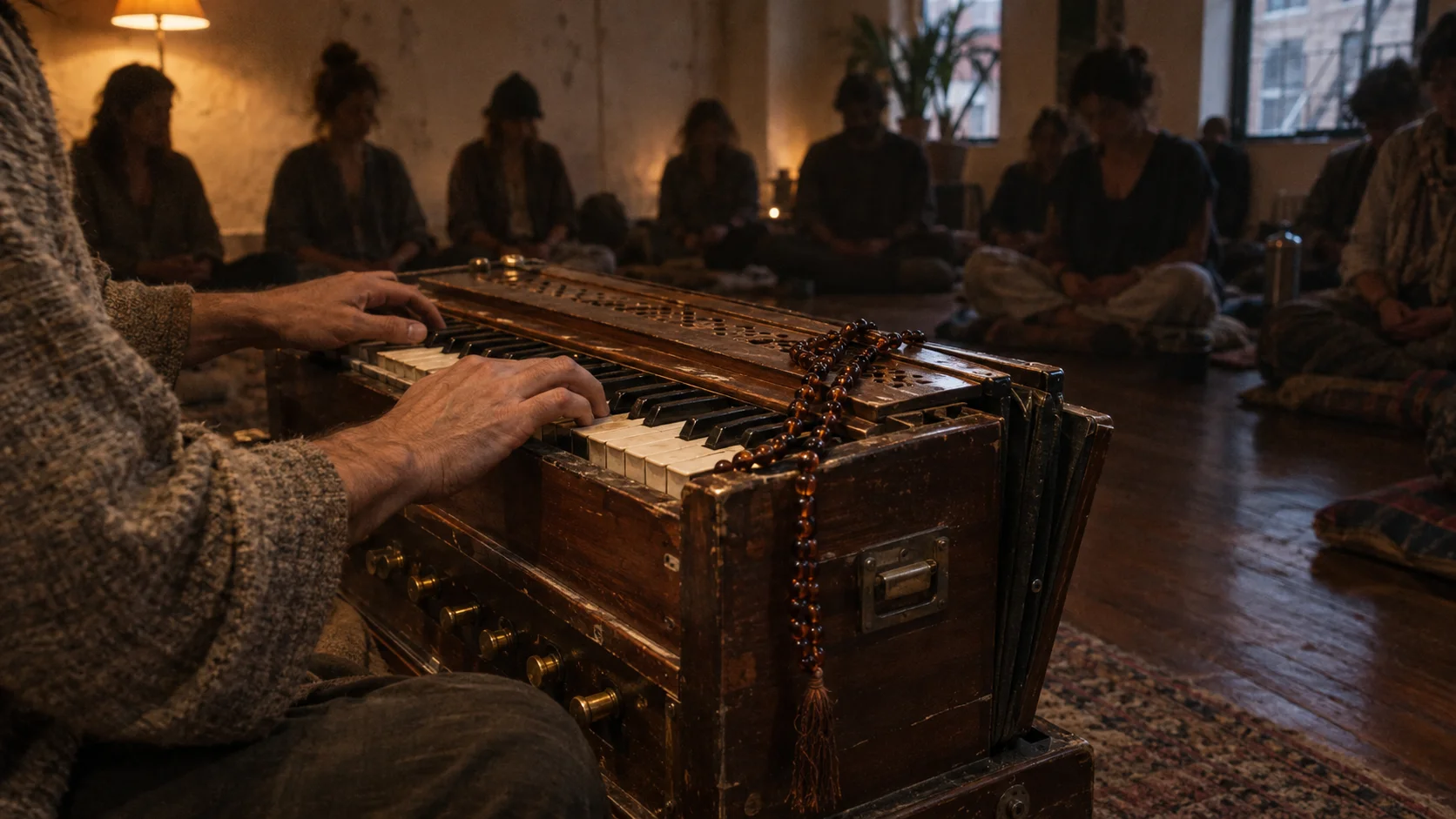
1. The Daily Discipline of Japa and Chant: Krishna Das dusted off an old hand-pumped Indian harmonium and sat on the floor. Every day, regardless of how dark his mood was or how intense his cravings were, he forced himself to sing the sacred mantras—the Hanuman Chalisa, the Maha Mantra (Hare Krishna), and Om Namah Shivaya. He did not treat chanting as an artistic performance; it was an act of raw survival.
2. The Jivamukti Chanting Circle: In 1994, friends invited him to lead a weekly chanting session in a small room at the Jivamukti Yoga Center in Manhattan. Initially, only a dozen people attended. Krishna Das sat on the floor with his eyes closed, pumping the harmonium bellows and repeating the names for hours. He used the collective voices in the room to drown out his internal demons.
3. Call-and-Response as a Cognitive Anchor: Kirtan functions through an ancient, rhythmic structure: the leader sings a sacred line, and the room repeats it back. This alternating cadence creates an unshakeable cognitive anchor. Each time his mind wandered into obsessive cravings or despair, the incoming wave of voices dragged his attention back to the present vibration.
4. Somatic and Nervous System Regulation: Chanting mantras aloud requires deep, prolonged exhalations. These extended vocalizations stimulate the vagus nerve, activate the parasympathetic system, slow the heart, and release endorphins, countering the hyper-aroused cravings of cocaine withdrawal.
5. Surrendering the Ego into the Sound: Whenever severe urges to use drugs struck, Krishna Das refused to debate with his cravings. Instead, he grabbed his prayer beads (mala) or sat at his instrument, chanting continuously until the neurochemical storm subsided: 'The Name is like a fire. Whether you put your hand in knowingly or unknowingly, it burns away the darkness.'
The Chant Master of American Yoga
Through the relentless, daily repetition of the sacred names, Krishna Das achieved what years of willpower could not: his addiction completely dissolved. He stopped using cocaine and heavy drugs permanently, without entering a rehabilitation facility, carried solely by the transformative power of chanting.
His weekly gatherings in Manhattan grew from a handful of seekers into standing-room-only crowds. In 1996, he released his debut album, 'One Track Heart.'
Over the next three decades, Krishna Das became an international cultural phenomenon. Hailed by The New York Times as 'the chant master of American yoga,' he popularized kirtan across the Western world, bridging traditional Indian devotional music with American gospel and rock sensibilities. In 2012, his album 'Live Ananda' was nominated for a Grammy Award for Best New Age Album, and he performed live on the Grammy stage.
In 2010, he published his spiritual autobiography, 'Chants of a Lifetime: Searching for a Heart of Gold' (Hay House), followed by the acclaimed documentary film 'One Track Heart: The Story of Krishna Das' (2012).
Krishna Das proved that human transformation does not require an untarnished past. By using the ancient technology of vocal chanting to confront his deepest wounds, he demonstrated that the voice itself is an instrument of liberation—capable of burning away decades of addiction and restoring joy to the human heart.