The Golden Cage and the Edge of Despair
By the late 1960s, Tina Turner—born Anna Mae Bullock—was internationally famous as the electrifying frontwoman of the Ike & Tina Turner Revue. On stage, she radiated raw power, athletic vigor, and joy. But offstage, her existence was a waking nightmare of severe domestic violence, coercive control, and financial subjugation.
Her husband and bandleader, Ike Turner, subjected her to systematic physical abuse, striking her with wooden shoe stretchers, burning her with cigarettes, and breaking her jaw and ribs. Beyond the physical brutality, Ike maintained complete psychological and financial dominance: all royalties, bank accounts, and publishing rights were kept in his name. Tina had no personal money, no legal recourse, and was constantly told that without Ike, she was a talentless nobody from Nutbush, Tennessee.
The ceaseless abuse and chronic exhaustion eventually broke her spirit. In 1968, backstage before a concert in Los Angeles, Tina swallowed fifty sleeping pills in an attempt to end her life. She woke in a hospital room with Ike standing over her, furiously demanding that she get back to work. Paralyzed by fear, low self-esteem, and maternal dread over how she could support her four children alone, Tina felt utterly trapped in an inescapable reality.

"Empowered by her practice, Tina fled Ike in July 1976 with 36 cents and a gas credit card."

The Vibration of the Mystic Law
In early 1973, in a Los Angeles recording studio, several people—including recording engineer Valerie Bishop and others—noticed Tina's quiet despair. They urged her to try a spiritual practice from Japan: chanting the sacred mantra of Nichiren Buddhism, 'Nam-myoho-renge-kyo' (I dedicate myself to the Mystic Law of the Lotus Sutra of Cause and Effect through sound).
Initially, Tina was skeptical. Having grown up in the Baptist church of the American South, repetitive chanting in an ancient Sino-Japanese language felt alien. Yet, with nothing left to lose, she secluded herself in a back room and began sounding the words aloud: 'Nam-myoho-renge-kyo... Nam-myoho-renge-kyo.'
Almost immediately, something shifted. She later described the physical sensation of the chant as a rhythmic vibration that reached deep into her subconscious, dissolving the numbness that had encased her heart. Rather than asking an external deity for deliverance, the practice taught that every human being possesses an innate, indestructible 'Buddha nature'—an inherent reservoir of wisdom, courage, and compassion that cannot be destroyed by external circumstances.
Tina adopted the practice with fierce, uncompromising discipline:
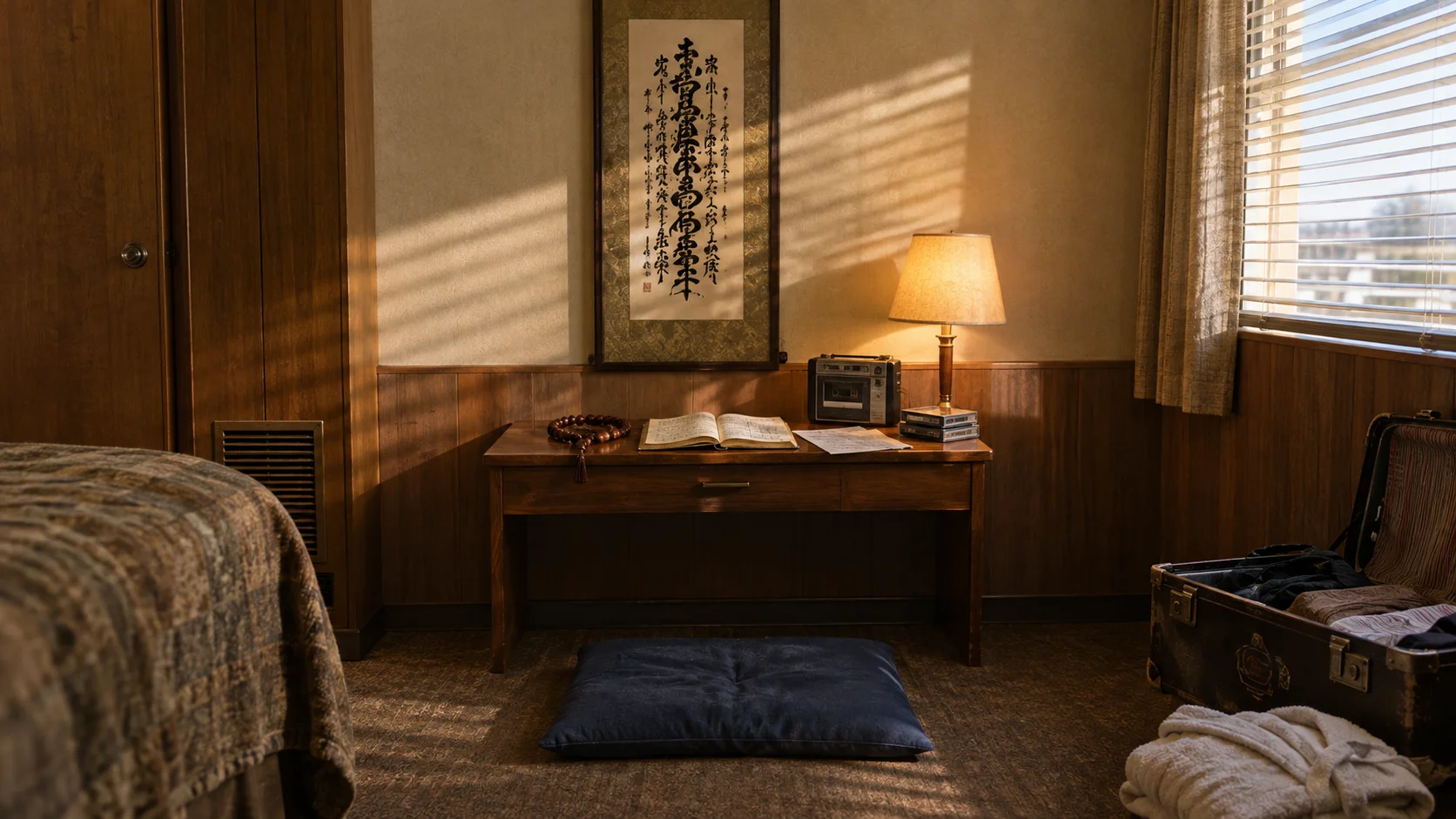
1. Daily Morning and Evening Chanting: Regardless of how late the Revue performed or how volatile the environment was at home, Tina woke early to chant facing a Gohonzon (a sacred scroll inscribed with Chinese characters representing the enlightened state of life). She sustained this twice-daily rhythm for decades.
2. Hours-Long Crisis Chanting: During periods of intense danger, emotional collapse, or severe conflict, Tina would retreat into a room and chant continuously for two, three, or even four hours at a stretch. She found that repetitive vocalization regulated her autonomic nervous system, quieting the adrenaline spikes of trauma and replacing panic with diamond-sharp clarity.
3. Recitation of the Lotus Sutra (Gongyo): Alongside the primary daimoku (chanting the mantra), she memorized and recited sections of the Lotus Sutra twice a day, using the rhythmic prose to steady her mind and train her focus.
4. Internal Cognitive Revolution: Through her daily practice, Tina underwent what Soka Gakkai Buddhism terms a 'human revolution.' She realized that while she could not change Ike's abusive behavior, she held total responsibility for her own life. She stopped seeing herself as a helpless victim of fate and began recognizing her own inherent power and dignity.
The chant gave Tina the internal fortitude to stop accepting violence as normal. In July 1976, while riding in a limousine in Dallas, Texas, Ike struck her again. For the first time in sixteen years, Tina fought back physically. Later that evening, after Ike fell into a drug-induced sleep at the Dallas Statler Hilton, Tina made her escape. Slipping down a fire escape, she ran across a multi-lane highway to a Ramada Inn with only thirty-six cents and a Mobil gasoline credit card in her pocket.
Phoenix from the Ashes to the Queen of Rock
Walking away meant financial catastrophe. To secure an immediate, uncontested divorce, Tina surrendered all claims to royalties, publishing rights, property, and shared assets, retaining only one thing: her stage name, Tina Turner.
Saddled with hundreds of thousands of dollars in debt from canceled Revue tour dates, she spent the late 1970s living on food stamps, cleaning friends' houses, and performing in small, dingy cabaret lounges to pay off promoters. Throughout these grinding, uncertain years, she never missed a day of chanting. The vocal discipline anchored her self-worth when record executives told her that, as a Black woman in her forties, her career was finished.
Instead of fading away, Tina engineered the most extraordinary comeback in rock-and-roll history. In 1984, at the age of forty-four, she released 'Private Dancer.' The album became an international sensation, selling over twenty million copies worldwide and generating multiple Grammy Awards, including Record of the Year for 'What's Love Got to Do with It.'
She filled stadiums across the globe, set Guinness World Records for the largest paying concert audience for a solo artist (180,000 people in Rio de Janeiro in 1988), and was twice inducted into the Rock and Roll Hall of Fame.
Until her death in May 2023 at age eighty-three, Tina credited her Buddhist chanting practice as the sole anchor that saved her life and restored her joy. In 2020, she published her spiritual memoir, 'Happiness Becomes You: A Guide to Changing Your Life for Good,' explicitly offering the lessons and methods of her fifty-year chanting discipline to help others transcend suffering and unlock their own inner light.