The Lubyanka and the Shadow of Execution
In March 1977, twenty-nine-year-old mathematician and computer specialist Anatoly (Natan) Sharansky was arrested on the streets of Moscow by the KGB. As a prominent Jewish 'refusenik' who had been denied an exit visa to emigrate to Israel and a key founding member of the Moscow Helsinki Watch Group monitoring Soviet human rights abuses, Sharansky had long been targeted by state surveillance.
This time, the Soviet state intended to destroy him completely. Accused of treason, espionage on behalf of the CIA, and anti-Soviet agitation under Article 64 of the Soviet Criminal Code, Sharansky faced execution by firing squad or fifteen years of hard labor in the Gulag.
Transferred to Moscow's Lefortovo Prison, Sharansky was plunged into total isolation. The KGB deployed a relentless psychological warfare strategy designed to break a prisoner's cognitive faculties: sensory deprivation, constant artificial lighting, sleep deprivation, and unending rounds of interrogation conducted by teams of specialized officers. He was cut off from all news of his family, his friends, and his young bride, Avital, who had received permission to emigrate to Israel just one day after their wedding in 1974.

When the world strips away your freedom and external agency, build an inviolable sanctuary within your own mind. Use structured, disciplined visualization and mental rehearsal to stay sharp, anticipate challenges, and anchor yourself to an unshakeable sense of purpose.

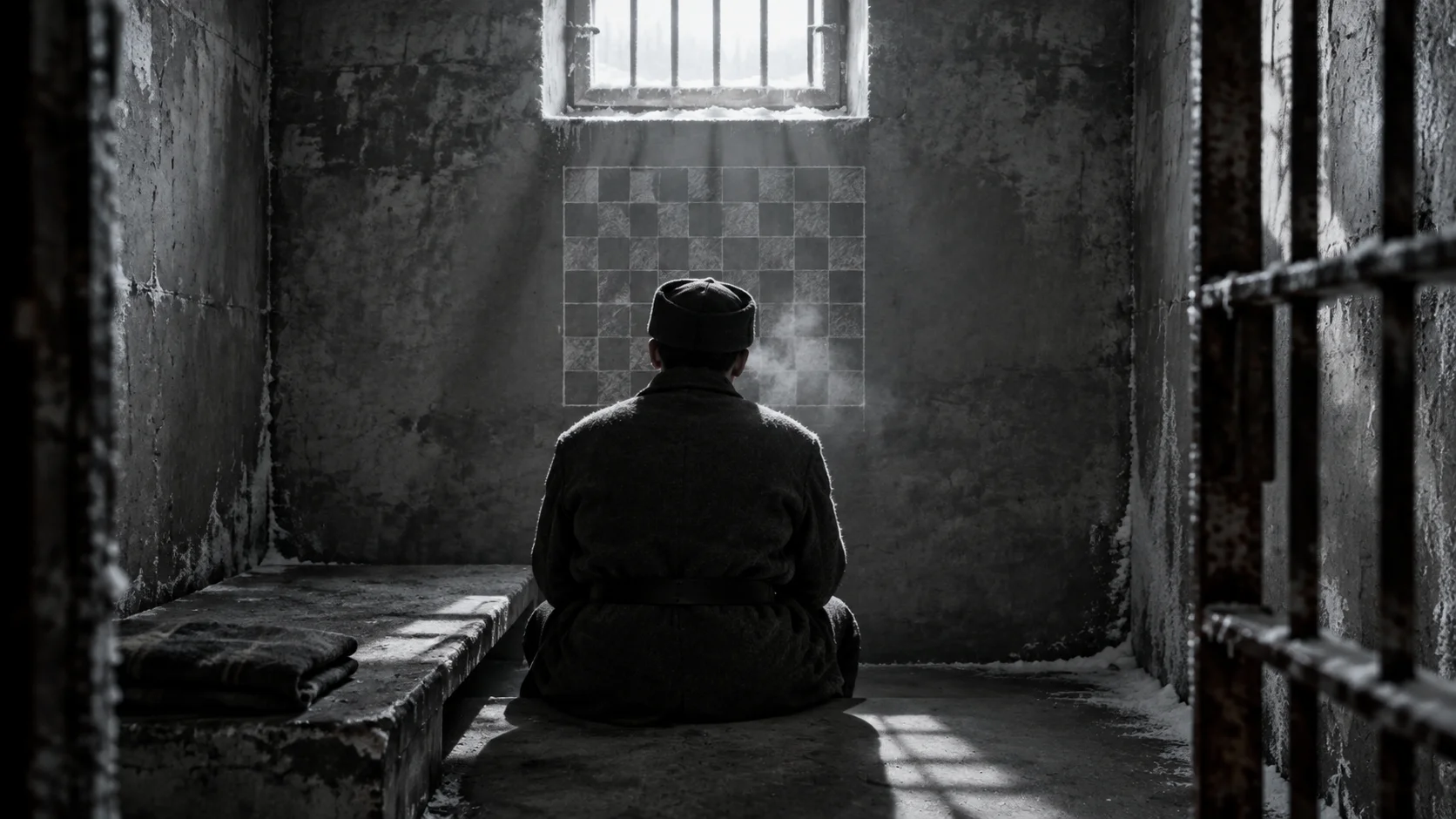
Later moved to Chistopol Prison and the Perm 35 labor camp in the Ural Mountains, Sharansky spent more than 400 days in the 'carcer'—freezing solitary punishment cells stripped of warmth, bedding, and human contact. Prisoners in the carcer were fed watery broth and a crust of bread every other day, shivering uncontrollably on bare concrete slabs in sub-zero draft. Under such sustained sensory deprivation, the mind naturally begins to deteriorate, falling into hallucinations, apathy, and eventual psychological surrender. Sharansky realized that if he did not find a rigorous, active discipline to anchor his intellect, his mind would dissolve.
The 64 Squares in the Dark
Deprived of paper, pencil, books, and human conversation, Sharansky turned inward. As a child prodigy in Donetsk, Ukraine, he had won the city chess championship at age fifteen and possessed the ability to play simultaneous blindfold games. He realized that the human imagination could serve as an impenetrable fortress that no interrogator could breach.
Sharansky began constructing a full-resolution chessboard entirely within his mind:
1. High-Fidelity Mental Projection: In the pitch-black cold of his punishment cell, Sharansky visualized an eight-by-eight grid of sixty-four black and white squares. He systematically rendered every rank and file (a1 to h8), holding the coordinates in working memory. He then populated the board with all thirty-two pieces in their starting positions, visualizing the distinct contours of pawns, knights, bishops, rooks, queens, and kings.
2. Dual-Role Blindfold Play: Without moving a finger, Sharansky played complete games against himself, alternating between White and Black. To maintain objective rigor, he forced himself to find the absolute strongest move from both perspectives, refusing to let one side play lazily. He calculated intricate tactical combinations ten to fifteen moves deep, visualizing branching trees of potential variations and holding the shifting piece positions steady in his mind. Over nine years, he played thousands of games. As he famously recounted to The New York Times: 'I played thousands of games in my head, and I won them all.'
3. Cognitive Interrogation Rehearsal: Sharansky applied the same mental chess methodology to his survival against the KGB. Each night, he mentally mapped out his upcoming interrogation sessions like opening repertoires. He visualized every line of questioning the KGB officers might deploy, anticipated their psychological traps, and rehearsed his principled, non-cooperative responses in advance. By pre-committing his tactical responses in his mind, he never hesitated, panicked, or surrendered confidential information during real interrogations.
4. Rhythmic Mental Recitation: When physical exhaustion made complex chess calculation difficult, Sharansky shifted to verbal rehearsal. He mentally recited the Psalms of King David from memory in Hebrew, using the rhythmic poetic cadence to steady his heartbeat, calm his nervous system, and tether himself to historical purpose.
5. Absolute Internal Boundaries: He established a non-negotiable mental boundary: he would never play by the KGB's rules or seek their favor. When guards offered minor comforts in exchange for cooperation, he declined. His internal world remained entirely his own.
The Bridge, the Crown, and the Grandmaster Defeat
Sharansky's mental discipline proved impregnable. Over nine years of brutal imprisonment, hunger strikes totaling more than 110 days, and extended spells in solitary confinement, he never signed a confession, never testified against fellow dissidents, and never compromised his principles.
On February 11, 1986, following a tireless global campaign led by his wife Avital, Sharansky was released in an international East-West prisoner exchange on the snow-covered Glienicke Bridge connecting East Germany to West Berlin. When his Soviet handlers instructed him to walk strictly in a straight line toward the Western delegation, Sharansky defied them one final time: he walked across the bridge in a deliberate zigzag, demonstrating that even on his final step of Soviet soil, his actions belonged solely to him.
Emigrating to Israel, Sharansky was reunited with Avital and emerged as a global human rights statesman. In 1988, he published his bestselling prison memoir, 'Fear No Evil.' He served as Deputy Prime Minister of Israel and Chairman of the Jewish Agency, receiving both the U.S. Congressional Gold Medal (1986) and the Presidential Medal of Freedom (2006).
In October 1996, World Chess Champion Garry Kasparov visited Jerusalem to conduct a simultaneous exhibition against twenty-five of Israel's top politicians and chess masters. Kasparov dismantled twenty-four opponents with ease. Only one player defeated the reigning world champion: Natan Sharansky. When asked how a busy government minister could topple the greatest chess player on Earth, Sharansky smiled and credited his survival in the Gulag: he had kept his strategic mind razor-sharp through thousands of hours of mental chess in Soviet punishment cells.