The Flaming Firebird and the Shattered Shin
In the spring of 2012, twenty-nine-year-old Misty Copeland stood on the threshold of ballet history. At the Metropolitan Opera House in New York City, she had been cast in the title role of Alexei Ratmansky's new production of The Firebird for American Ballet Theatre (ABT)—one of the most prestigious classical dance companies in the world. As an African American woman who had started ballet late at age thirteen and battled systemic racial exclusion in the ultra-traditional dance world, dancing the lead at the Met was the culmination of everything she had fought for.
Yet behind the blazing crimson costume and the thunderous standing ovations, Copeland was dancing through unbearable physical agony. Her left shin throbbed with a burning, bone-deep pain that left her barely able to walk offstage. Driven by adrenaline, fierce pride, and the knowledge that young dancers of color were looking up to her, she masked her grimaces with stage smiles and completed the historic run.
Immediately following the final performance, MRI and CT scans revealed a catastrophic diagnosis: Copeland had six distinct stress fractures along her left tibia. Three of them were compound, near-complete breaks through the bone that threatened to snap her leg entirely. Orthopedic surgeons performed complex surgery, inserting a titanium plate and five screws into her shinbone to stabilize the fractures. The medical prognosis was grim: doctors warned her that her career as an elite classical ballerina was likely over. Even if her bone healed, surgeons cautioned that she might never withstand the impact of jumping on hard stages or dancing on pointe again.
The Studio Chair, Motor Imagery, and Floor Barre
Confronted with the sudden loss of her physical identity, Copeland faced months of forced immobility. For an elite athlete whose daily existence depended on eight hours of physical exertion, the silence was suffocating. Yet Copeland refused to accept the finality of her diagnosis. Understanding that the brain and body are linked by shared neural circuits, she engineered an innovative, non-weight-bearing rehabilitation discipline:
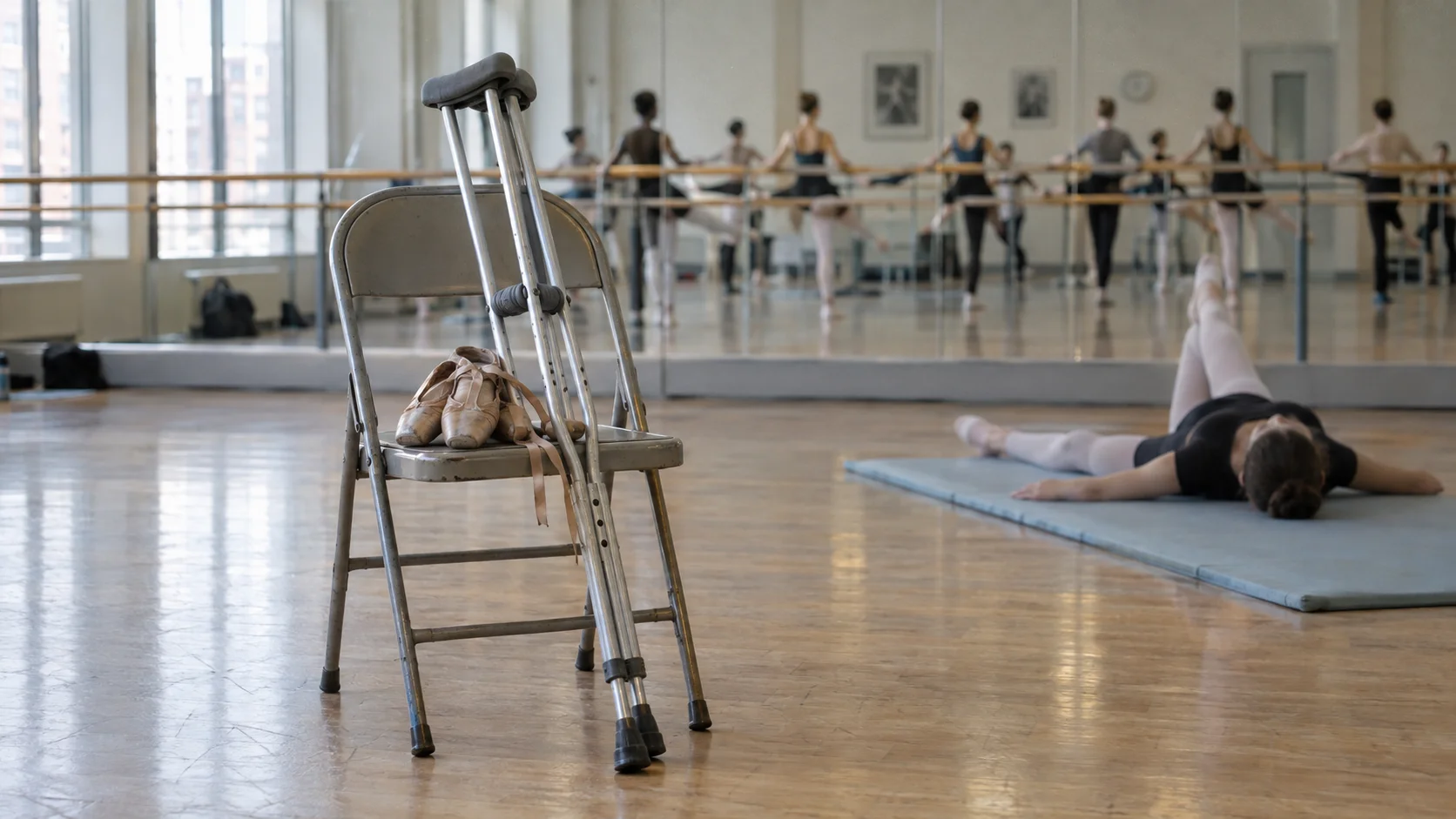
1. Daily Seated Mental Rehearsal (Motor Imagery): Unable to put weight on her left foot, Copeland refused to stay home. Every morning, she arrived at the ABT studios on crutches, pulled a folding chair into the rehearsal room, and sat watching company class and rehearsals for hours. As music played, she closed her eyes and engaged in systematic motor imagery—mentally dancing every combination in vivid, high-resolution detail. She visualized the exact placement of her feet, the tension in her core, the rotation of her hips, and the coordination of her arms, feeling the micro-firings of her muscles without bearing an ounce of physical load.
2. Floor Barre Conditioning: To maintain alignment and core strength without gravitational impact on her tibia, Copeland adopted the Zena Rommett Floor-Barre technique. Lying flat on her back on a studio mat, she executed classical ballet barre exercises—pliés, tendus, and battements—relying on the floor's flat surface to correct imbalances, preserve joint mobility, and strengthen her pelvic stabilizers while her shinbone knitted around the titanium plate.
3. Emotional Visualization and Re-framing Anxiety: As she detailed in her memoir Ballerina Body, Copeland used visualization not just for physical choreography, but for psychological mastery. Whenever doubt or trauma from her injury surfaced, she visualized stepping onto the stage with total confidence, breathing through nervousness, and transforming anxiety into grounded artistic poise.
4. Gradual Impact Progression: When bone scans finally showed solid fusion after eight months, Copeland did not rush back to full jumps. She transitioned methodically: first practicing pliés in water, then rising onto relevé at the barre, and only gradually introducing low-impact center work, testing her mental blueprints against physical reality.
Center Stage at the Metropolitan Opera House
When Misty Copeland finally returned to the rehearsal studio, her physical therapists and artistic directors were stunned. Despite having been sidelined for nearly a year, her neuromuscular coordination, rhythmic timing, and muscle memory were astonishingly sharp. The hours spent mentally rehearsing in her chair had kept the neural pathways in her motor cortex active, preventing the cognitive atrophy that typically derails injured dancers.
Her comeback exceeded every expectation. In 2014, she made her historic debut in the demanding dual role of Odette and Odile in Swan Lake with the ABT in Australia, followed by a triumphant performance at the Met. Then, on June 30, 2015, American Ballet Theatre made a historic announcement: Misty Copeland was promoted to principal dancer—the first African American woman to achieve the company's highest rank in its seventy-five-year history.
Documented in the critically acclaimed film A Ballerina's Tale and her New York Times bestselling memoirs Life in Motion and Ballerina Body, Copeland became a global ambassador for classical dance and athletic perseverance. Named one of Time magazine's 100 Most Influential People, she demonstrated that when the physical body is temporarily broken, the mind can step forward as the primary training instrument—turning an injury that could have ended a career into the foundation of a historic legacy.