Seizures, Weak Bones, and the Virar Chawl
Before he became known to millions as "Chi Chi"—the tirelessly energetic dancing superstar of 1990s Hindi cinema—Govind Arun Ahuja spent his childhood in severe financial and physical distress. After his father, former actor and producer Arun Ahuja, lost the family fortune on a failed film production, the family was forced to sell their Carter Road bungalow in Mumbai and relocate to a modest tenement chawl in Virar, a distant northern suburb.
Growing up as the youngest of six children, Govind faced an even more frightening obstacle than poverty: a debilitating neurological and physical decline during his early teens. As Govinda later recounted in a public address documented by Navbharat Times and News Nation, by age thirteen his bones had grown so weak that walking felt exhausting, and he suffered from recurring epileptic seizures (mirgi). Without warning, he would lose consciousness and collapse. During one severe episode, his jaw locked so violently that several of his teeth chipped and broke at once.
Because he could faint at any moment, he was warned not to walk alone along busy roads or stand near elevated ledges. As the condition dragged on, the emotional toll deepened. Extended relatives who initially offered sympathy gradually grew weary of his chronic illness and distanced themselves. Sitting in doctors' clinics in his early teens, a frightened Govind repeatedly asked his physicians whether he would ever live a normal, healthy life—let alone fulfill his dream of becoming a leading actor when industry insiders dismissed his appearance and background.
A Mother's Sankalpa and the Seven-Year Gayatri Purashcharana
The turning point arrived as Govind approached his fourteenth birthday. His mother, Nirmala Devi—a revered Hindustani classical vocalist of the Patiala gharana and an ascetic devotee who had raised her children through years of hardship—refused to accept that her youngest son was destined for lifelong frailty.
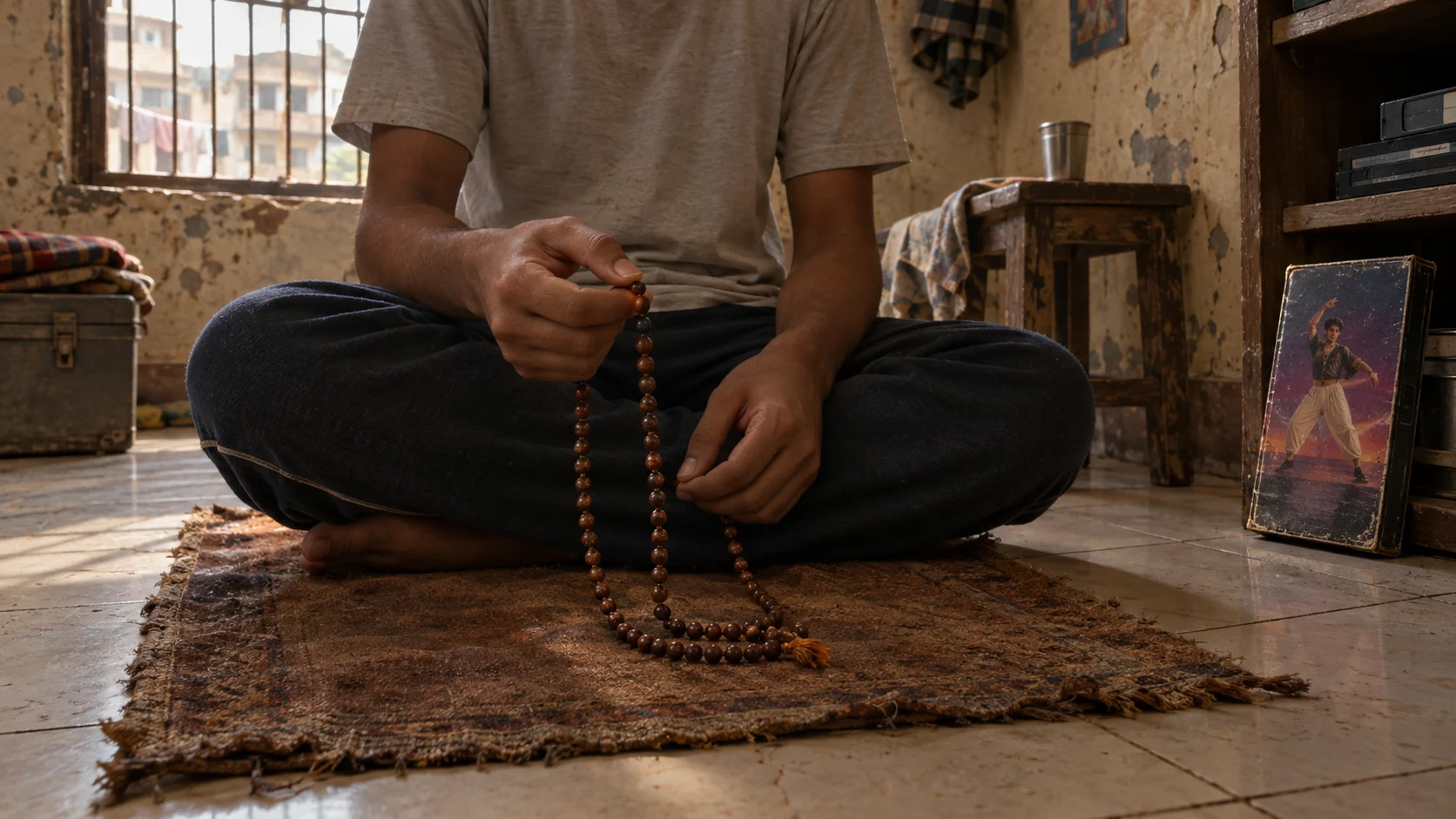
Drawing on the ancient Vedic tradition of Purashcharana (a structured vow of mantra repetition performed over a fixed period of years), Nirmala Devi brought fourteen-year-old Govind a prayer mat (aasan) and a string of 108 prayer beads (japa mala). She gave him a solemn instruction: from age fourteen until he turned twenty-one, he was to complete 24 lakh (2.4 million) recitations of the Gayatri Mantra—and in later accounts noted by The Times of India, extended his total sadhana to 48 lakh recitations.
For a fourteen-year-old boy in a crowded Virar house, the mathematics of that vow required extraordinary daily discipline:
"When illness or adversity makes the future look impossible, anchor yourself in a steady daily practice—breaking even a monumental multi-year vow into faithful daily repetitions until your strength and confidence return."
1. Nearly 1,000 Recitations Every Single Day: Completing 2.4 million recitations across seven years (roughly 2,555 days) required chanting approximately 940 to 1,000 Gayatri Mantras every day—equivalent to nine to ten full rounds of a 108-bead mala, or two to three hours of uninterrupted seated japa daily.
2. Seated Asana and Breath-Synchronized Japa: Each morning before beginning his day, Govind sat cross-legged on his prayer mat, turning the beads between his thumb and middle finger while reciting the twenty-four-syllable Vedic hymn. While Govinda personally attributes his subsequent healing to divine grace and his mother's spiritual vow, modern clinical research notes that hours of slow, rhythmic Sanskrit mantra chanting naturally regulates respiration to roughly six breaths per minute, stimulating the vagus nerve, stabilizing autonomic arousal, and reducing stress-induced seizure triggers alongside medical treatment.
3. Pairing Spiritual Discipline With Relentless Dance Practice: As his physical stamina and confidence began to stabilize in his late teens, Govind watched Mithun Chakraborty's 1982 film Disco Dancer and began practicing dance routines for hours on end. He combined his daily mantra sadhana with commerce studies at Annasaheb Vartak College in Vasai and recorded a promotional VHS cassette of his dancing to show film producers.
4. Numerological Reinvention and Unwavering Faith: Completing his seven-year vow at age twenty-one, he adopted the screen name "Govinda" and walked into Mumbai film offices with an unshakeable inner conviction that the years of austerity had prepared him for his breakthrough.
Signing 49 Films in 50 Days
When Govinda turned twenty-one—the exact milestone his mother had set seven years earlier—his life transformed at breathtaking speed. As he recounted on India TV's Aap Ki Adalat, the young man who had once been unable to walk down a street alone without fear of collapsing saw his seizure episodes and bone weakness subside completely, giving way to boundless physical stamina.
In 1986, at age twenty-two, his debut films Love 86 and Ilzaam released to roaring box-office success, immediately establishing his electric dancing style and magnetic screen presence. Within just fifty days of his debut release, Govinda signed forty-nine films, launching a three-decade career encompassing more than 165 Hindi films—including iconic blockbusters such as Aankhen (1993), Raja Babu (1994), Coolie No. 1 (1995), Hero No. 1 (1997), and Partner (2007).
Reflecting on his journey decades later, Govinda consistently credits his mother Nirmala Devi and those seven quiet years on a prayer mat in Virar. Whether viewed through the lens of traditional Vedic faith or the psychophysiological resilience forged by seven years of unwavering daily meditation, his story demonstrates how a structured, multi-year discipline can carry a young person from chronic illness and hopelessness to extraordinary vitality.