Fifteen Years on Two Canes and a Heavy Back Brace
During the 1991 Gulf War, Arthur Boorman served as an airborne infantry paratrooper in the United States Army. The physical demands of military service took a brutal toll: jumping out of aircraft with heavy combat rucksacks delivered crushing impacts upon landing. Over years of service, the violent shock waves destroyed his spinal column and blew out both knees.
When Boorman was discharged, his body was broken. Military orthopedic specialists and Veterans Affairs doctors delivered a grim diagnosis: his knees were permanently degenerated, his lower spine was severely damaged, and he would never walk without mechanical assistance again.
For fifteen years, Boorman accepted that prognosis as a life sentence.
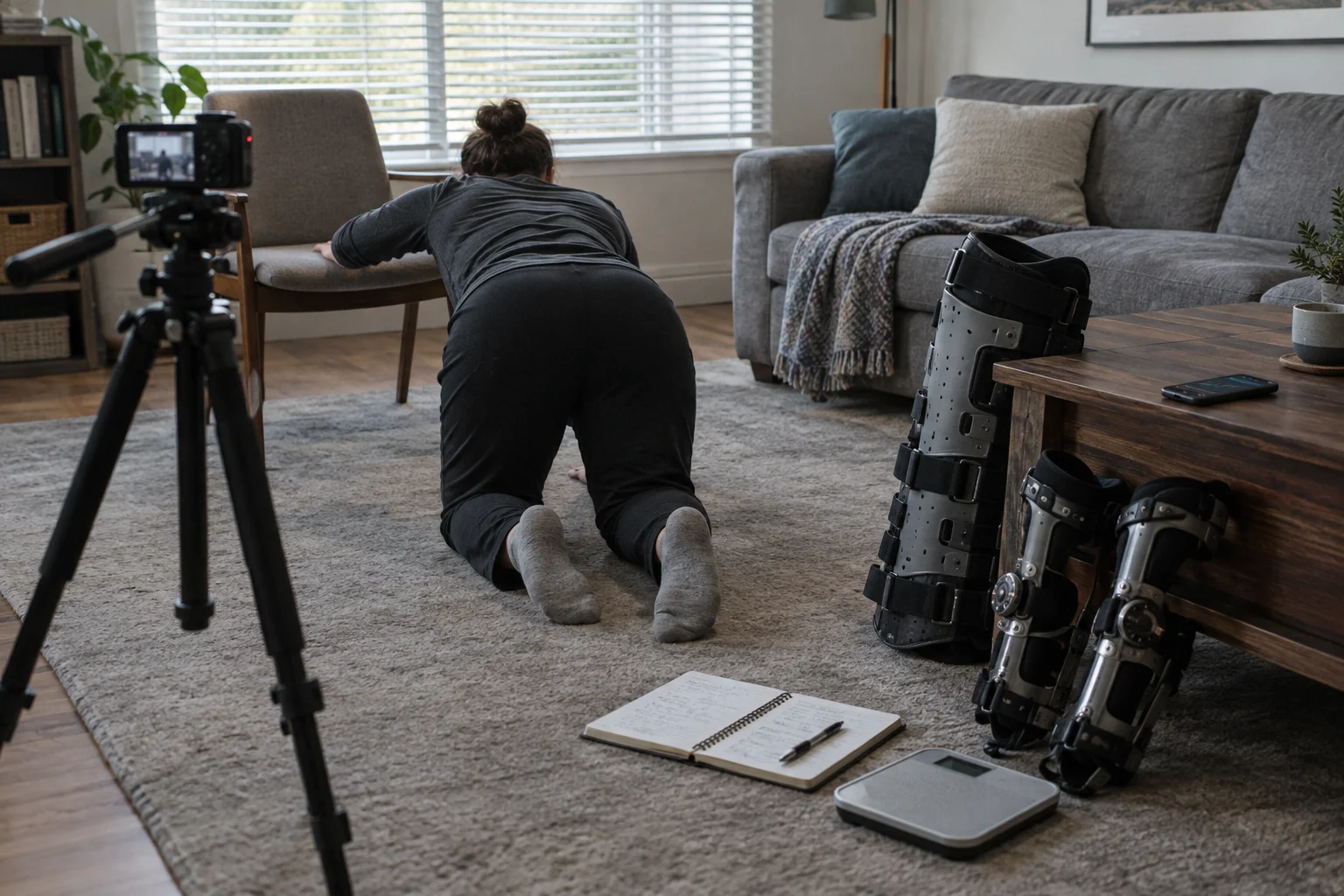
Without the ability to run or walk, his health deteriorated rapidly. Unable to exercise, he turned to food for comfort. By 2007, at age forty-seven, Boorman stood five feet eight inches tall and weighed 297 pounds. His mobility required an armor of medical gear: hinged metal braces on both knees, a rigid back brace around his torso, and two heavy forearm crutches that he dragged across the floor with every step.
Simple acts—getting out of a chair, playing with his children, or navigating a single step—required exhausting physical exertion. Trapped in chronic pain and depression, Boorman felt like a burden to his family. He had given up on himself, assuming that the rest of his life would be spent in a declining body.
Falling on the Living Room Floor and Refusing to Quit
The catalyst arrived in 2007. Frustrated by his declining quality of life, Boorman researched low-impact workouts online. He contacted traditional yoga studios, but instructors turned him away, terrified that his spinal injuries made him an impossible liability.
Only one person answered his email: Diamond Dallas Page (DDP), a former professional wrestling champion who had developed a specialized rehabilitation system called DDP Yoga after breaking his own back in the ring. DDP sent Boorman instructional DVDs, paired him with an unrefined whole-food nutrition plan, and checked in by phone.
When Boorman watched the initial movements, the prospect seemed laughable. He was nearly three hundred pounds, could not balance on one leg, and could not stand without crutches. Yet Boorman committed to a daily, home-based rehabilitation protocol:
1. Starting from the Living Room Floor: Unable to perform standing postures, Boorman began on his hands and knees on the carpet. Using a chair and couch for support, he practiced gentle spinal flexions, low-impact hip openers, and basic core stabilization.
2. Dynamic Resistance Without Joint Load: The core of the practice was dynamic resistance—engaging opposing muscle groups simultaneously without external weights. This elevated his heart rate into the fat-burning zone without pounding his knee cartilage or compressing his vertebrae.
3. The Discipline of Falling and Getting Back Up: During the first three months, Boorman fell constantly. Lacking balance and core strength, his legs buckled, sending him crashing onto the floor. For Boorman, falling became the central discipline: every time he collapsed onto the carpet, he took a deep breath, gathered his strength, and dragged himself back up to try again.
4. Diaphragmatic Breath Control: Chronic pain had locked Boorman into shallow, panic-driven mouth breathing. Following the breathwork cues, he learned slow, diaphragmatic nasal respiration, activating the parasympathetic nervous system to manage intense physical discomfort during deep stretches.
5. Daily Video Accountability: To hold himself accountable, Boorman set up a video camera on a tripod, recording his workouts, his falls, and his weigh-ins. Seeing microscopic improvements in flexibility week after week gave him tangible proof that his nervous system was responding.
6. Eliminating Inflammatory Foods: Working with DDP's guidance, Boorman stripped his diet of junk food, dairy, and processed sugars, shifting to clean proteins, vegetables, and whole foods to reduce systemic joint inflammation.
Throwing Away the Crutches and Running Free
The transformation that followed shocked every physician who had evaluated Boorman over the prior fifteen years.
Within the first six weeks, Boorman shed over twenty pounds and regained enough core stability to walk across his living room with only one cane.
At the three-month mark, his knees had stabilized so profoundly that he removed his metal leg braces forever. At eight months, he walked out of his home completely unassisted, carrying his forearm crutches under his arm before discarding them in the trash.
By ten months, Boorman had lost an astonishing 140 pounds, weighing in at a lean, muscular 157 pounds. Most remarkably, the man who had been told he would spend his life on crutches began jogging, running across open fields, and executing complex, acrobatic balancing headstands that even seasoned yoga practitioners struggle to hold.
In May 2012, a time-lapse video documenting his journey—titled 'Never, Ever Give Up: Arthur's Inspirational Transformation'—was uploaded to YouTube. The video went viral globally, amassing tens of millions of views, and was featured on ABC News, Good Morning America, and CNN.
Diamond Dallas Page documented Boorman's transformation in his 2019 book, 'Positively Unstoppable: The Art of Owning It' (Rodale Books / Penguin Random House), and Boorman went on to become a certified fitness instructor, dedicating his life to helping disabled veterans and mobility patients.
Arthur Boorman proved that human potential is not dictated by medical statistics or past diagnoses. By taking ownership of his health, meeting failure with patience, and showing up on the floor every single day, he demonstrated that it is never too late to rebuild a shattered life.